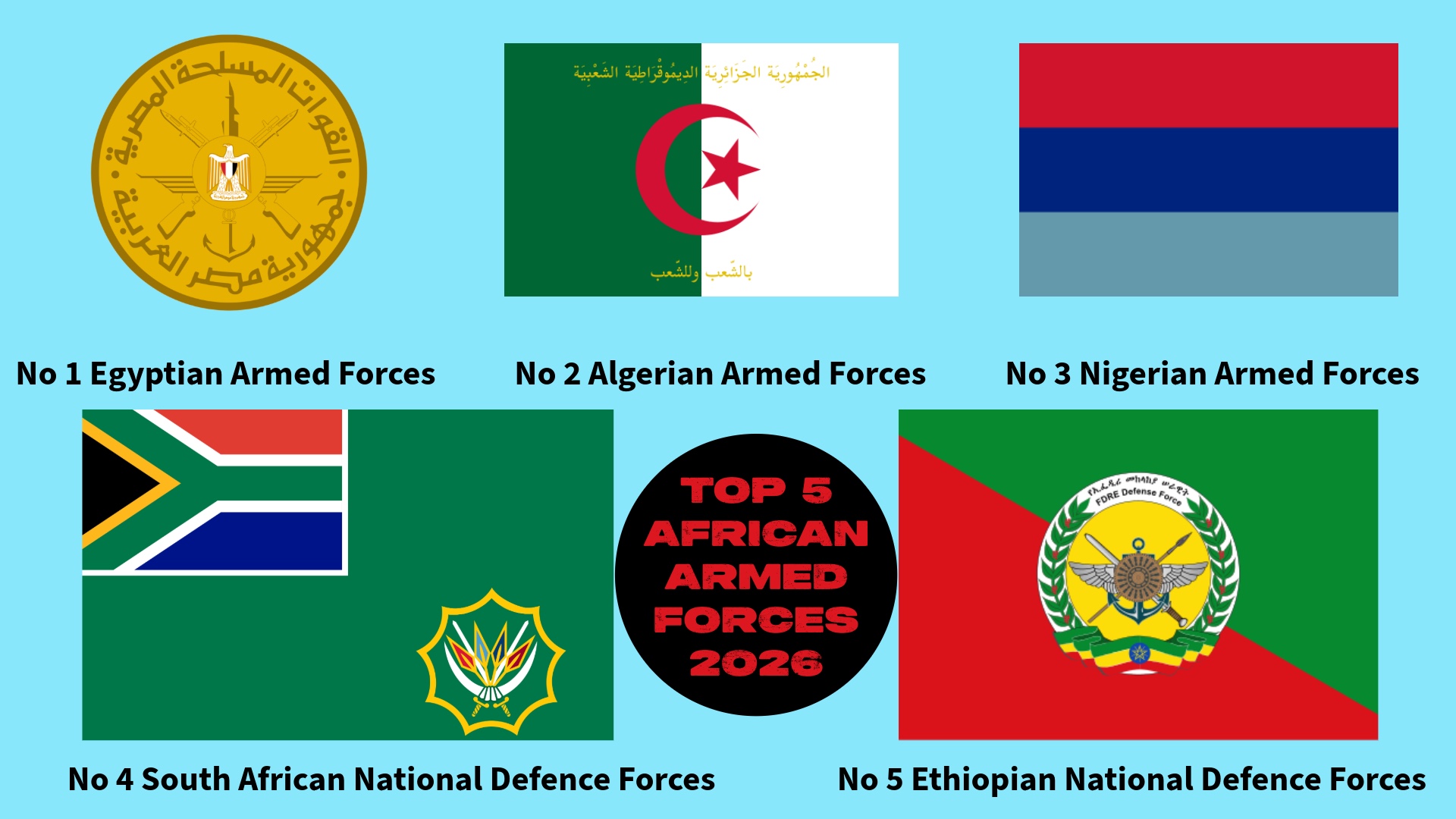
According to Global Firepower (GFP) 2026, the African Union (AU), taken as a single aggregated military entity, would rank among the largest armed forces in the world by manpower and equipment volume. On paper, Africa fields millions of active and reserve personnel, thousands of armored vehicles, hundreds of combat aircraft, and extensive naval assets spread across coastal and inland states.
Yet the central paradox remains unchanged: Africa possesses military mass, but not military power.
The GFP data for 2026 reinforces a long-standing reality—African military strength is fragmented, unevenly distributed, technologically inconsistent, and politically constrained. The AU’s challenge is not force generation, but force integration.
What Global Firepower Measures—and What It Doesn’t
Global Firepower evaluates military strength using over 60 indicators, including:
-
manpower
-
air, land, and naval assets
-
logistics and mobility
-
financial resources
-
geography
-
industrial base
Importantly, GFP does not measure:
-
political cohesion
-
interoperability
-
command integration
-
intelligence fusion
-
sustainment under prolonged conflict
These omissions matter deeply in the African context.
When the AU is viewed collectively through the GFP lens, it appears formidable. But military power in practice depends on how forces are used together, not how many exist separately.
Manpower: Quantity Without Uniform Quality
Africa’s greatest numerical advantage remains manpower.
GFP 2026 shows that the AU collectively commands one of the largest pools of:
-
active-duty soldiers
-
paramilitary forces
-
reserves
Countries such as Egypt, Algeria, Ethiopia, Nigeria, South Africa, and Morocco anchor this manpower base. However, training standards, readiness levels, and professionalisation vary widely.
Many African armies remain:
-
infantry-heavy
-
under-mechanised
-
reliant on legacy doctrine
-
constrained by weak NCO corps
Manpower alone does not translate into deterrence or rapid response—especially against asymmetric threats such as insurgencies, militias, and cross-border terror networks.
Air Power: Capability Concentrated, Not Continental
GFP 2026 highlights a stark imbalance in African air power.
A small number of states—most notably Egypt, Algeria, Morocco, Nigeria, and South Africa—possess meaningful combat aviation capabilities, including fighter jets, attack helicopters, and ISR platforms.
The majority of AU members rely on:
-
limited transport aircraft
-
aging helicopters
-
minimal air defense coverage
-
outsourced ISR
This concentration creates a strategic asymmetry: continental missions depend on a handful of air forces, limiting the AU’s ability to conduct rapid, sustained operations without external support.
Drones are changing this equation—but unevenly. While some states have adopted UAVs aggressively, many lack the intelligence infrastructure and command systems to use them effectively.
Land Forces: Heavy Equipment, Light Integration
Africa’s land forces account for the bulk of its military assets.
According to GFP:
-
armored vehicles and artillery are widely distributed
-
main battle tanks remain concentrated in North Africa
-
logistics and engineering units are scarce continent-wide
The key weakness is mobility and sustainment.
Most African armies struggle with:
-
long-distance deployment
-
joint logistics
-
maintenance cycles
-
ammunition stockpile management
As a result, even large formations often operate below full effectiveness after short operational periods.
Naval Power: Regional, Not Strategic
African naval strength in GFP 2026 is modest relative to continental size and maritime exposure.
Capabilities are strongest in:
-
North Africa (Mediterranean focus)
-
South Africa (blue-water potential)
-
Nigeria (Gulf of Guinea security)
Elsewhere, navies are largely:
-
coastal patrol–oriented
-
underfunded
-
poorly networked
This limits the AU’s ability to secure:
-
sea lines of communication
-
offshore energy infrastructure
-
maritime trade corridors
Piracy, smuggling, and illegal fishing remain persistent precisely because naval strength is not pooled or integrated.

The AU as a Military Actor: Structural Constraints
The African Union does not command a standing army.
Instead, it relies on:
-
ad hoc force contributions
-
regional standby brigades
-
political consensus among member states
The African Standby Force (ASF)—envisioned as the AU’s rapid-response mechanism—remains largely aspirational in 2026. While regional components exist, they are unevenly funded, rarely exercised jointly, and politically constrained.
Global Firepower’s aggregated AU strength therefore masks a critical truth: Africa’s military power is national, not continental.
Regional Disparities: The Real Story Behind the Numbers
GFP data underscores sharp regional divides:
-
North Africa: conventionally strong, state-centric militaries with armor, air defense, and industrial depth.
-
West Africa: manpower-rich but stretched by internal security operations.
-
East Africa: battle-hardened forces, often overstretched by multiple conflicts.
-
Southern Africa: smaller but more professionalized forces.
-
Central Africa: weakest overall capability, despite high instability.
These disparities complicate collective action and undermine AU-wide deterrence.
External Dependence: The Silent Variable
Perhaps the most important insight not captured directly by GFP is external dependency.
African militaries remain heavily reliant on:
-
foreign ISR
-
external airlift
-
overseas training
-
imported spare parts
-
donor-funded operations
As a result, Africa’s effective military strength is often conditional, not autonomous.
This reality shapes how and when force can be used—particularly in crises requiring rapid escalation or sustained operations.
What the GFP 2026 Rankings Really Tell Us
Taken seriously, the GFP 2026 African Union dataset reveals three core truths:
-
Africa has scale, not synergy
-
Capability is concentrated, not shared
-
Power exists nationally, not institutionally
This explains why:
-
insurgencies persist despite large armies
-
peacekeeping strains national forces
-
external actors retain outsized influence
From Strength to Power: What Must Change
If the AU is to convert military mass into real power, four shifts are essential:
-
Intelligence integration
Shared ISR, data fusion, and early-warning systems. -
Democratic command mechanisms
Clear political authority for rapid deployment. -
Logistics pooling
Airlift, maintenance, and sustainment must be collective. -
Professionalisation over expansion
Better-trained forces matter more than larger ones.
Conclusion: Africa’s Military Future Is a Political Choice
Global Firepower 2026 confirms that Africa is not weak—it is disconnected.
The African Union’s challenge is not building armies, but building trust, interoperability, and command cohesion. Until that happens, Africa’s military strength will remain impressive on paper, but limited in effect.
Power is not what you own.
Power is what you can deploy—together, quickly, and decisively.
In 2026, Africa still has work to do.
Majemite Jaboro is a London based defence analyst


Leave a Reply