

The Low-Altitude Battlefield That Could Decide the War
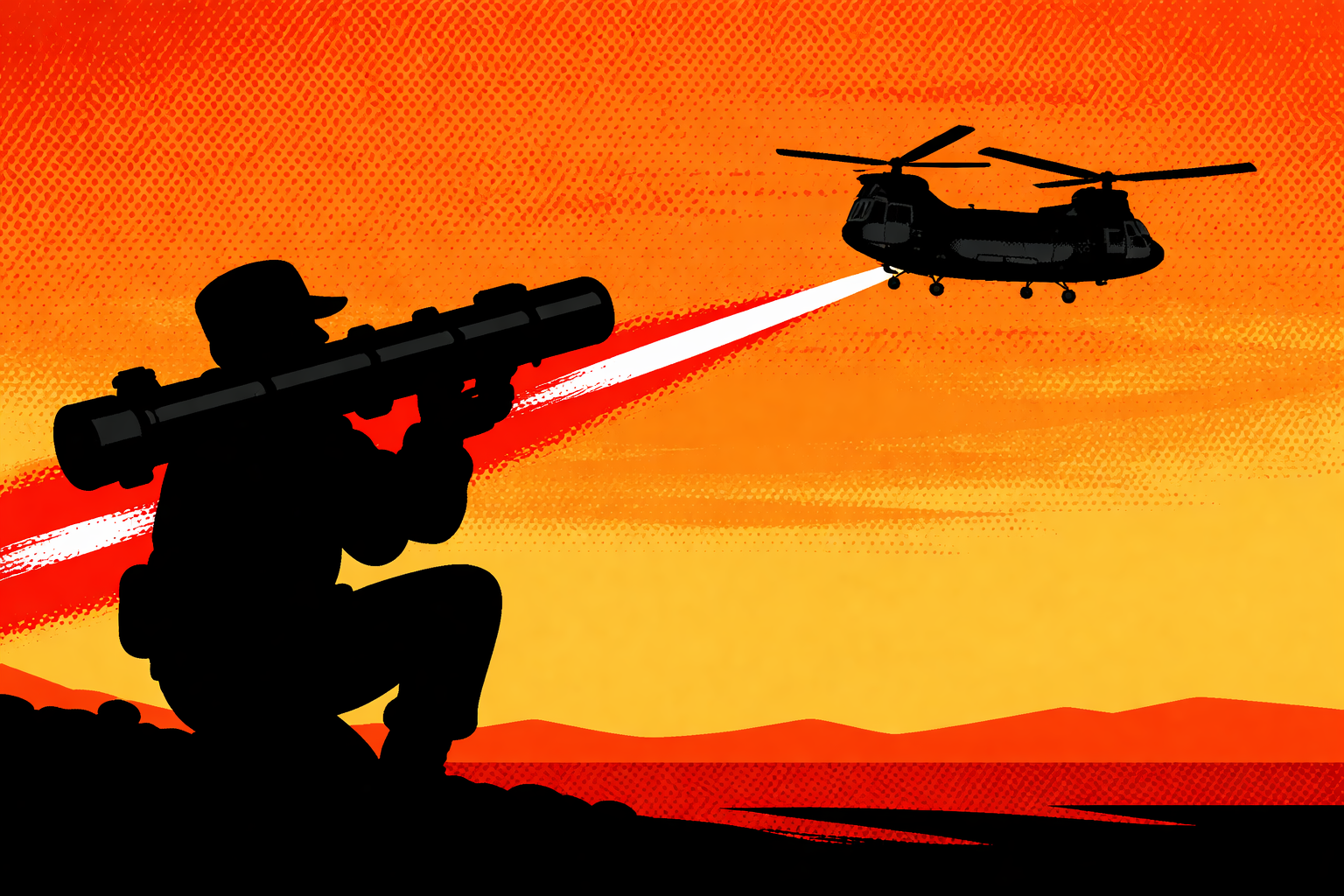
In modern warfare, air superiority is often defined at high altitude—stealth fighters, bombers, and long-range missiles dominate strategic narratives. But in the evolving U.S.–Iran conflict, the decisive battle may unfold far lower, in a far more dangerous zone: the helicopter battlespace.
This is where wars are won or lost on the ground.
And in this domain, Iran is preparing a trap.
Why Helicopters Matter More Than Ever
For the United States military, helicopters are not optional—they are foundational. Platforms like the Chinook, Black Hawk, and Apache form the backbone of troop insertion, medical evacuation, logistics, and close air support.
Unlike jets, helicopters enable control of terrain. They move soldiers into contested zones, resupply forward units, and sustain momentum in any ground campaign.
Strip away helicopter mobility, and modern expeditionary warfare slows to a crawl.
This dependency creates a structural vulnerability.
“The U.S. cannot move without helicopters” is not rhetoric—it is doctrine.
Iran’s Asymmetric Playbook: Attack the Weakest Link
Iran understands this dependency clearly—and has built its battlefield strategy around it.
Rather than competing with the United States in high-end air combat, Tehran has invested heavily in layered, low-altitude air defence systems, particularly man-portable air-defence systems (MANPADS).
These are simple, mobile, and deadly.
Crucially, they are everywhere.
Iran’s doctrine disperses these systems across multiple forces:
- Islamic Revolutionary Guard Corps (IRGC) ground units
- Basij paramilitary fighters
- Regular army formations
This creates a dense, unpredictable threat environment.
Unlike fixed air defence systems that can be targeted and destroyed, MANPADS teams are mobile, concealed, and persistent. They can operate from urban areas, mountains, coastlines, or even civilian infrastructure.
As one assessment notes, a large number of modern MANPADS could significantly complicate U.S. helicopter operations in any conflict with Iran .
The Physics of Vulnerability
Helicopters are uniquely exposed to this threat.
Unlike fast jets, they:
- Fly low
- Move relatively slowly
- Operate within visual and infrared targeting range
- Must hover or reduce speed during landing and extraction
This makes them ideal targets for heat-seeking missiles.
The most dangerous moment is not transit—it is insertion.
When a Chinook descends into a landing zone, it becomes a predictable, slow-moving target. A single MANPADS operator, properly positioned, can alter the outcome of an entire mission.
History reinforces this vulnerability.
In Ukraine, helicopters have suffered significant losses to portable air defence systems, with a large proportion of losses occurring during low-altitude operations .
The lesson is clear: low altitude equals high risk.
From Air Superiority to Air Denial
The U.S. and Israel currently dominate the conflict at long range, relying on stand-off strikes and strategic bombers. But that advantage fades dramatically closer to the ground.
Iran does not need to win the skies—it only needs to deny access to them.
This is the essence of air denial warfare.
Mobile air defence systems—especially infrared-guided missiles—can appear suddenly, fire, and disappear. These “shoot-and-scoot” tactics compress reaction times for pilots to seconds.
Recent battlefield analysis highlights that road-mobile and hidden air defence systems can emerge virtually anywhere, leaving aircrews little time to react .
This creates a constant state of uncertainty.
Pilots are not just flying—they are guessing.
The Basij Factor: Mass and Saturation
One of Iran’s most significant advantages is not technology—but scale.
The Basij militia provides Iran with a large pool of semi-trained fighters who can operate basic air defence systems. This allows Tehran to saturate potential landing zones and transit corridors with dispersed missile teams.
This is not precision warfare—it is probability warfare.
Even if most missiles miss, the presence of many launchers increases the chance of a successful hit.
And in helicopter warfare, one hit is enough.
The Cost Equation: Cheap Missiles vs Expensive Aircraft
The economics of this battlefield heavily favour Iran.
A MANPADS missile costs tens of thousands of dollars.
A Chinook helicopter costs tens of millions.
The asymmetry is stark.
This mirrors a broader trend in the war, where low-cost systems—such as drones—are being used to challenge expensive Western platforms, creating unsustainable cost imbalances .
In this context, Iran does not need to destroy many helicopters.
It only needs to make their use too risky.
Operational Consequences: What Happens If Helicopters Fail
If U.S. helicopter operations are degraded, the impact would be immediate and severe:
1. Reduced Mobility
Troops cannot be inserted quickly into contested areas.
2. Logistical Breakdown
Supply chains slow down, increasing vulnerability of ground forces.
3. Higher Casualties
Medical evacuation delays directly increase fatality rates.
4. Operational Paralysis
Without air mobility, offensive operations stall.
This is not theoretical.
Modern military doctrine assumes rapid mobility. Remove that, and the tempo of war collapses.
Iran’s Expanding Low-Altitude Defence Network
Iran is not standing still.
Recent developments indicate efforts to expand low-altitude defence capabilities, including the acquisition of newer MANPADS systems and integration of short-range interception platforms designed to engage drones, helicopters, and low-flying missiles.
These systems are increasingly networked into a broader integrated air defence architecture, combining radar, missiles, and dispersed launch units .
The result is a layered threat environment where:
- High-altitude systems deter aircraft
- Low-altitude systems kill helicopters
The Strategic Dilemma for the United States
The United States now faces a difficult choice.
Continue relying on stand-off warfare—and accept limited ground control.
Or risk deeper engagement—and expose helicopters to a dense, lethal threat environment.
Neither option is ideal.
Avoiding helicopter use limits operational reach.
Using them risks losses that could shift public perception and strategic momentum.
Conclusion: The War Within the War
The headlines focus on missiles, bombers, and naval power.
But beneath that lies a quieter, more dangerous contest.
A war for control of the lowest layer of the sky.
If Iran succeeds in turning that space into a kill zone, it will not need to defeat the United States outright.
It will only need to slow it down.
Because in modern warfare, mobility is power.
And helicopters are mobility.
Take them out of the equation—and the entire campaign begins to unravel.
Majemite Jaboro writes for DWA
Leave a Reply