
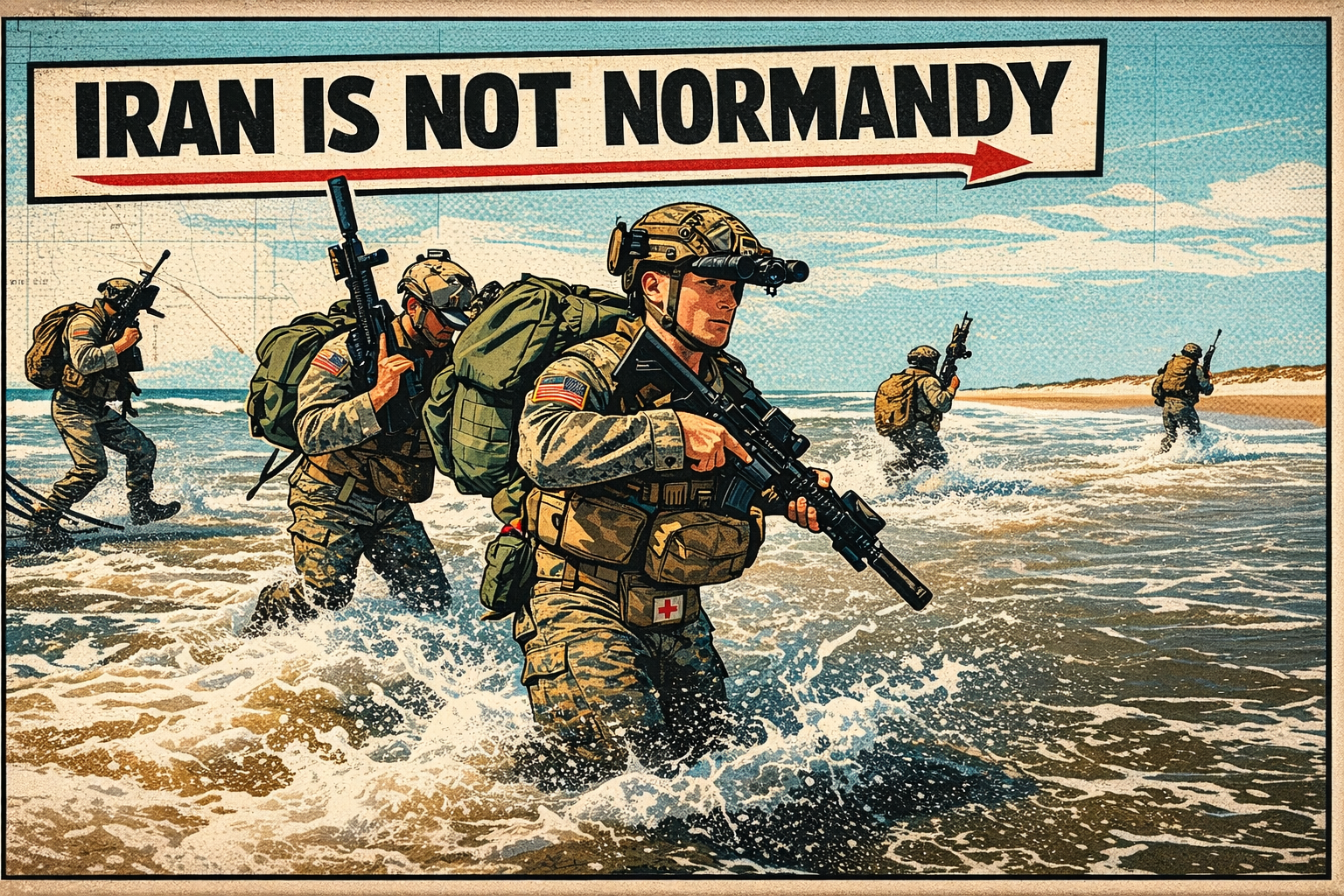

A FORCE BUILT FOR ENTRY, NOT RESOLUTION
The concentration of United States amphibious forces around the Strait of Hormuz—centred on the USS Tripoli and USS Boxer and their embarked Marine Expeditionary Units—has revived a familiar narrative of decisive intervention. The imagery is compelling: Marines storming hostile shores, supported by their own air wings, while the 82nd Airborne drops inland to fracture resistance and seize key terrain. It suggests speed, dominance, and a clear operational pathway. Yet this vision rests on a flawed premise. The battlespace in Hormuz is not suited to decisive manoeuvre warfare. It is a constrained littoral environment shaped by a decentralised Iranian doctrine specifically designed to absorb, fragment, and outlast a superior force.
The two Marine Expeditionary Units at the centre of this posture—the 31st MEU aboard Tripoli and the 11th MEU aboard Boxer—represent the United States’ most flexible rapid-response capability. Each is a self-contained combined-arms force of roughly 2,200 to 2,500 Marines, built around an infantry battalion landing team, a composite aviation squadron, and a logistics element. Their aviation component, including F-35B fighters, attack helicopters, and MV-22 Osprey aircraft, provides mobility, strike capability, and close air support. Amphibious vehicles, light armour, and artillery allow them to seize and hold limited objectives. Alongside them, the potential deployment of the 82nd Airborne Division introduces a vertical assault component. As the Army’s Global Response Force, the 82nd can deploy rapidly to seize key infrastructure, but it remains lightly equipped and dependent on rapid reinforcement. Together, these forces form a powerful entry capability—but not a force designed for prolonged occupation under sustained pressure.

THE MOSAIC DOCTRINE: A SYSTEM DESIGNED NOT TO BREAK
At the centre of Iran’s defensive posture is a doctrine built to counter precisely this kind of intervention. Known as Mosaic Defence, it emerged during a period of restructuring under the Islamic Revolutionary Guard Corps in the mid-2000s. Drawing heavily on lessons from Iraq and Afghanistan, where decentralised insurgent networks proved resilient against technologically superior forces, the doctrine divides the country into a network of provincial commands, each capable of operating independently.
Local commanders are pre-authorised to act without central direction, effectively functioning as autonomous decision-makers if communications with Tehran are disrupted. The aim is to render “decapitation strikes” ineffective. Removing senior leadership does not collapse the system; it causes it to fragment and continue fighting. This creates a form of organised decentralisation in which each region can sustain operations regardless of the fate of the centre.
Iran’s military structure reinforces this approach. The conventional Artesh provides traditional territorial defence, while the Revolutionary Guard operates as a parallel force with its own ground, naval, and aerospace elements. It is within the Guard that Mosaic Defence is embedded, supported by an emphasis on asymmetric warfare—drones, mobile missile systems, fast attack craft, and dispersed ground units designed to prolong conflict and impose cumulative strain.

Majemite Jaboro a UK based defence analyst writes for DWA



Leave a Reply