
The decision by Donald Trump to impose a naval blockade on Iran marks a dramatic escalation in U.S. strategy in the Middle East. Framed as a show of strength following the collapse of negotiations in Islamabad, the move is intended to choke Iran’s oil exports and force political concessions.
Yet beneath the surface, the blockade carries the hallmarks of a strategy that is far more difficult to sustain than to announce. From geography and military doctrine to economics and global politics, multiple structural factors point toward one conclusion: the blockade is unlikely to achieve its stated objectives—and may instead accelerate instability.
Geography: The Strait That Cannot Be Sealed
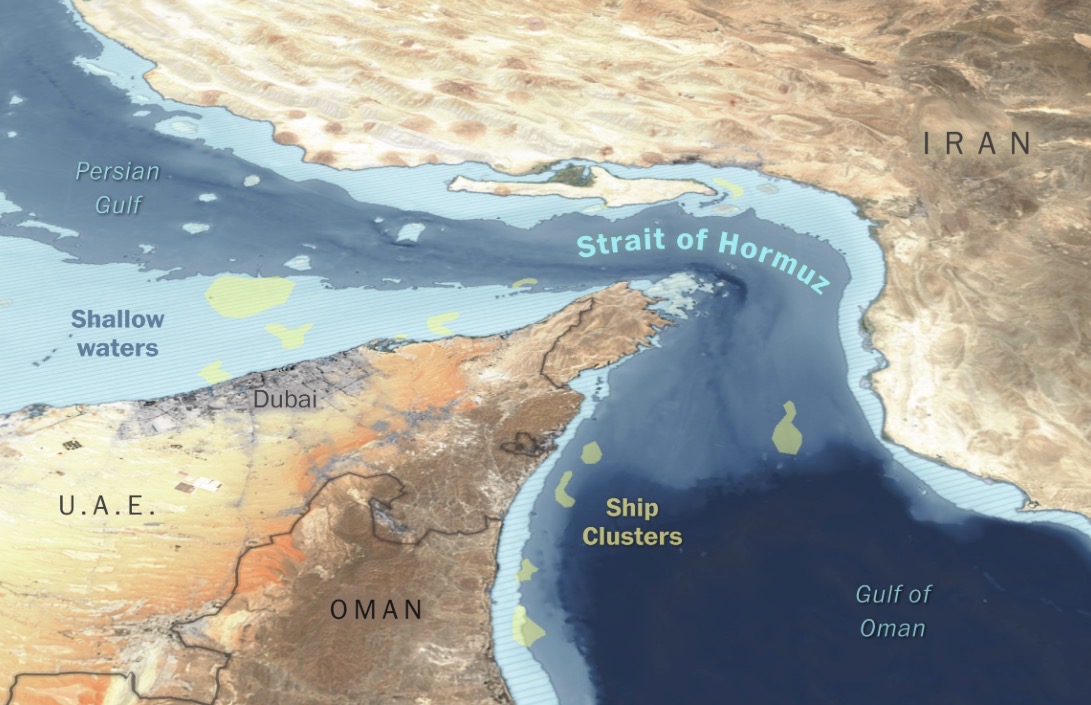
At the centre of the crisis lies the Strait of Hormuz, a narrow maritime corridor through which roughly 20% of global oil supply flows. While the U.S. Navy can deploy overwhelming force, geography constrains what that force can realistically achieve.
The Strait is not open ocean. It is a congested, tightly bounded waterway, with Iran controlling much of the northern coastline. This allows Tehran to project power from land—using coastal missile systems, drones, and radar—while U.S. forces operate at a logistical distance.
Crucially, monitoring traffic is not the same as stopping it. Maritime experts have long argued that no navy, however powerful, can fully seal a chokepoint with such high commercial volume. Early indications that vessels are still transiting under alternative arrangements reinforce this reality.
A blockade that cannot fully block quickly becomes a signalling exercise rather than a decisive tool.
Asymmetric Warfare: Iran’s Core Advantage
The imbalance in conventional military power between the United States and Iran is well understood. What is often underestimated is how effectively Iran has designed its doctrine to offset that imbalance.
The Islamic Revolutionary Guard Corps (IRGC) specialises in asymmetric naval warfare—deploying fast attack craft, naval mines, drones, and anti-ship missiles in coordinated operations designed to disrupt rather than defeat.
In the confined waters of the Gulf, these tactics are particularly potent. Large U.S. warships, while technologically superior, are exposed to swarm attacks and difficult-to-detect threats such as mines. The objective for Iran is not to destroy the U.S. Navy outright, but to raise operational risks and costs to unsustainable levels.
This is a strategy of attrition. The longer the blockade continues, the more the balance shifts away from overwhelming power toward persistent disruption.
Economic Blowback: The Market Will Decide
The most immediate vulnerability in the blockade strategy lies not in military capability, but in economics. Global energy markets are acutely sensitive to disruptions in the Gulf. Even limited interference in shipping can trigger sharp price increases.
Oil price spikes—potentially reaching $150–$200 per barrel in a worst-case scenario—would reverberate across the global economy, fuelling inflation and slowing growth. For major importers such as China and India, the incentive to maintain energy flows will outweigh alignment with U.S. policy.
For Washington, the political implications are equally significant. Rising fuel prices translate directly into domestic pressure. Historically, U.S. administrations have struggled to sustain foreign policy actions that impose visible economic costs on voters.
In this sense, the blockade is vulnerable not just to Iranian resistance, but to market forces that Washington does not control.
Strategic Isolation: A Coalition That Isn’t There
Unlike previous large-scale maritime operations, the current blockade appears to lack a robust international coalition. Key European allies—including the UK and Germany—have signalled reluctance to participate.
This absence matters. Maritime enforcement at scale requires coordination, intelligence-sharing, and legal alignment across multiple states. Without it, the burden falls disproportionately on U.S. forces, increasing both operational strain and political exposure.
More critically, the lack of consensus undermines legitimacy. Countries that do not recognise the blockade as lawful or necessary are less likely to comply—and more likely to test its limits.
China’s continued engagement with Iran underscores this point. If major powers openly bypass the blockade, it ceases to function as a global constraint.
Enforcement Reality: Too Much Ocean, Too Many Ships
A naval blockade is not a static action—it is a continuous process requiring surveillance, interception, and verification across vast maritime space. The scale of commercial traffic in and around the Gulf makes total enforcement exceptionally difficult.
Shipping networks are highly adaptive. Vessels can change routes, ownership structures, or documentation to evade scrutiny. Iran, with decades of experience under sanctions, has developed sophisticated mechanisms to facilitate such workarounds.
Even a small percentage of successful evasions can undermine the blockade’s effectiveness. Over time, this creates a pattern of partial compliance that erodes both credibility and deterrent value.
In practical terms, the U.S. does not need to fail completely for the blockade to fail strategically. It only needs to be inconsistent.
Time and Political Will
One of the most decisive asymmetries in this confrontation is temporal. Iran’s political system is structured to endure prolonged pressure. Economic hardship, while significant, does not translate directly into policy reversal.
The United States, by contrast, operates within electoral cycles and media scrutiny. Public opinion, particularly in the context of rising costs or military risk, imposes limits on how long such an operation can be sustained.
This dynamic favours Iran. The longer the blockade persists without clear success, the more pressure builds on Washington to adjust course.
Escalation Risk Without Strategic Clarity
A blockade is inherently escalatory. Intercepting vessels, confronting Iranian forces, or responding to asymmetric attacks all carry the risk of broader conflict.
Yet the strategic objective remains ambiguous. Is the goal to force negotiations, weaken Iran economically, or signal deterrence? Without clarity, the operation risks becoming an open-ended commitment with no defined endpoint.
This ambiguity increases the danger of miscalculation. A single incident—whether accidental or deliberate—could trigger escalation beyond the original scope of the blockade.
Early Indicators: Cracks in the System
Initial reports suggest that maritime traffic has not been fully halted. Some vessels are continuing to transit through alternative arrangements, highlighting the difficulty of comprehensive enforcement.
These early cracks are significant. They suggest that Iran retains agency within the Strait, and that the blockade may evolve into a contested, partial restriction rather than a decisive shutdown.
Once that perception takes hold, the deterrent effect weakens, and compliance declines further.
Conclusion: A Strategy at Odds With Reality
The U.S. retains overwhelming naval superiority. But the challenge in the Strait of Hormuz is not simply one of power—it is one of control, sustainability, and legitimacy.
The blockade faces a convergence of constraints: difficult geography, effective asymmetric resistance, economic backlash, limited international support, and the inherent complexity of maritime enforcement. Against this backdrop, Iran does not need to win outright. It only needs to endure and adapt.
For BusinessDay readers, the strategic takeaway is clear: this is less a decisive military move than a high-risk pressure tactic with uncertain returns. If current trends hold, the blockade is likely to erode over time—undermined not by a single failure, but by the cumulative weight of structural realities.
In that sense, the question is no longer whether the blockade will succeed, but how quickly its limits will become impossible to ignore.


Leave a Reply