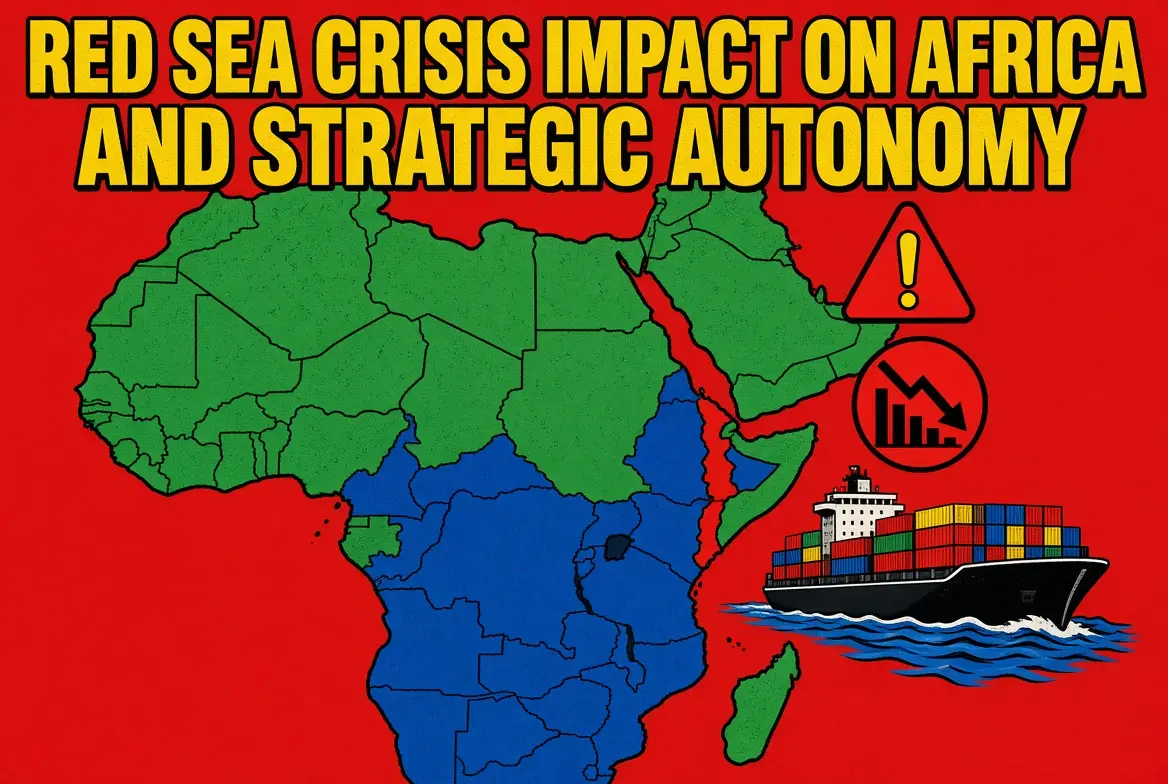
The Red Sea crisis impact on Africa is not confined to delayed containers or higher freight invoices. It is a stress test of the continent’s exposure to maritime chokepoints it does not control, supply chains it does not govern, and security decisions taken far beyond African waters. When commercial vessels avoid the Bab el-Mandeb Strait and divert around the Cape of Good Hope, African states inherit the costs of a conflict whose principal military actors lie elsewhere.
The disruption began with attacks on commercial shipping linked, directly or indirectly, to the conflict in Gaza. The immediate response from many shipping lines was operational rather than political: avoid the Red Sea, pass south around Africa, accept longer voyages and higher costs. Yet that commercial calculation has strategic consequences. The Suez Canal and Red Sea form one of the world’s most important corridors between Asia, Europe and Africa. Their insecurity reveals how quickly a regional confrontation can reshape African economic security.
Why the Red Sea crisis matters to African security
The Red Sea is often discussed as a Middle Eastern theatre. Geographically and strategically, it is also an African one. Egypt, Sudan, Eritrea, Djibouti and Somalia sit on, or immediately beside, the wider maritime system affected by instability in Yemen. Ethiopia and South Sudan depend heavily on regional port infrastructure. Kenya, Tanzania, Mozambique and South Africa are drawn into its consequences through trade flows, insurance pricing, port activity and naval deployments.
For Egypt, the danger is particularly acute. Suez Canal receipts are a vital source of foreign currency, and fewer transits undermine public finances at a time when fiscal space is already constrained. This is not simply a shipping-sector problem. Foreign exchange shortages can affect debt servicing, imports, energy procurement and political stability. The security of a canal therefore becomes inseparable from the resilience of the state that administers it.
For the Horn of Africa, the crisis reinforces an uncomfortable reality: proximity to a strategic waterway does not automatically produce strategic control. Djibouti hosts an unusually dense concentration of foreign military facilities, while major external powers maintain naval interests across the western Indian Ocean. Their presence can provide deterrence and surveillance, but it also means African territory may be treated as infrastructure for outside campaigns rather than as a platform for African-defined maritime security.
Trade disruption becomes domestic pressure
A rerouted voyage around southern Africa can add significant distance, fuel consumption and time. For import-dependent economies, those additional costs rarely remain at sea. They move through freight rates, marine insurance premiums, wholesale prices and, eventually, household budgets. Governments may face pressure to subsidise fuel, staple foods or transport at precisely the moment revenues are under strain.
The exposure is not identical across the continent. North African and East African markets that rely on regular links to Asian suppliers can face delays in manufactured goods, fertiliser, machinery and consumer products. Food-importing states are especially vulnerable where shipping disruption compounds currency depreciation, drought or conflict. A delayed consignment is manageable for a large firm with inventory and credit. It is far more damaging for a small importer, a pharmacy, a miller or a public procurement agency operating with thin margins.
African exporters also bear costs. Perishable agricultural products, minerals requiring predictable delivery schedules, and time-sensitive manufactured goods lose competitiveness when transit times become uncertain. Longer routes may reduce the number of effective sailings available to smaller ports. The issue is not merely whether a ship can arrive, but whether buyers can trust the delivery date and price on which a contract was based.
The Cape route is an opportunity, but not a windfall
South Africa and neighbouring coastal economies may gain some additional demand for bunkering, repairs, provisions and emergency port calls as vessels round the Cape. This has encouraged speculation that the crisis could revive the strategic value of southern African ports. There is truth in that assessment, but it should not be overstated.
A diverted vessel does not automatically create local economic value. Shipping lines will only make port calls where turnaround times, fuel availability, harbour services, customs procedures and security conditions are reliable. Congestion, weak rail connections and ageing infrastructure can convert a geographic advantage into a missed opportunity. The Cape route also carries its own weather and scheduling risks. African governments should distinguish between temporary traffic and durable logistics competitiveness.
Maritime insecurity exposes a capability gap
The crisis has renewed attention on naval power, but the relevant lesson for Africa is broader than acquiring more warships. Maritime security depends on maritime domain awareness, functioning coastguards, port security, intelligence fusion, legal authority, maintenance capacity and co-operation between civilian and military institutions. A navy without reliable surveillance, logistics and command systems cannot secure a vast exclusive economic zone or protect commercial approaches effectively.
The Red Sea also demonstrates the changing nature of sea denial. Relatively inexpensive drones, missiles and targeting networks can impose costs on the world’s largest commercial fleets and force sophisticated navies into expensive defensive operations. African maritime planners should take this seriously. Critical ports, offshore energy installations, subsea cables and naval bases are increasingly exposed to low-cost precision threats.
That does not mean every African state should pursue an expensive missile programme or replicate the naval posture of larger powers. It does mean that coastal states require a clear threat assessment and proportionate defences. In some cases, the priority will be coastal radar and patrol aviation. In others, it will be hardened port infrastructure, counter-drone measures, better intelligence sharing or legal mechanisms to prosecute illicit activity at sea. The correct investment depends on geography, trade dependence and available institutions.
The sovereignty question behind foreign naval protection
External naval escorts can reduce immediate risks to shipping, and African states have legitimate reasons to co-operate with partners that can protect sea lanes. But reliance on outside fleets carries a strategic trade-off. Those fleets answer first to their own governments, their commercial interests and their wider military objectives. Their priorities can change abruptly when another theatre becomes more urgent.
African governments should therefore avoid treating foreign military presence as a substitute for regional capability. The African Union’s maritime strategy and regional security mechanisms offer a framework, but frameworks require sustained funding, interoperable systems and political direction. The most valuable gains may come from practical co-operation: shared shipping information, harmonised port procedures, joint training, coastguard development and stronger links between customs, navies and commercial operators.
The Red Sea crisis also strengthens the case for African representation in discussions over maritime rules, sanctions enforcement and the protection of commercial navigation. Too often, African states are consulted after external powers have defined the operational problem and the acceptable solution. This leaves the continent responding to decisions that shape its trade costs, military posture and diplomatic room for manoeuvre.
Red Sea crisis impact on Africa and the next policy test
The immediate task is to manage disruption without allowing it to become a permanent vulnerability. Finance ministries need realistic contingency planning for higher import costs and lower transit revenues. Port authorities need to identify which upgrades would turn emergency diversions into reliable commercial activity. Defence and transport ministries need to treat maritime resilience as a shared national-security responsibility rather than separate bureaucratic portfolios.
There is also a diplomatic test. African states should resist false choices between silence and alignment with one external bloc. Their interest is in protecting freedom of navigation, preventing the wider militarisation of African waters, preserving civilian trade and defending the sovereignty of coastal states. That position can be principled without becoming subordinate to another power’s regional agenda.
The most useful response to this crisis will not be a dramatic declaration or a procurement spree. It will be the quieter work of building institutions that can see, absorb and act when distant conflict reaches African shores. Strategic autonomy begins with that capacity: knowing where dependence lies, deciding which risks are unacceptable, and investing before the next chokepoint closes.


Leave a Reply