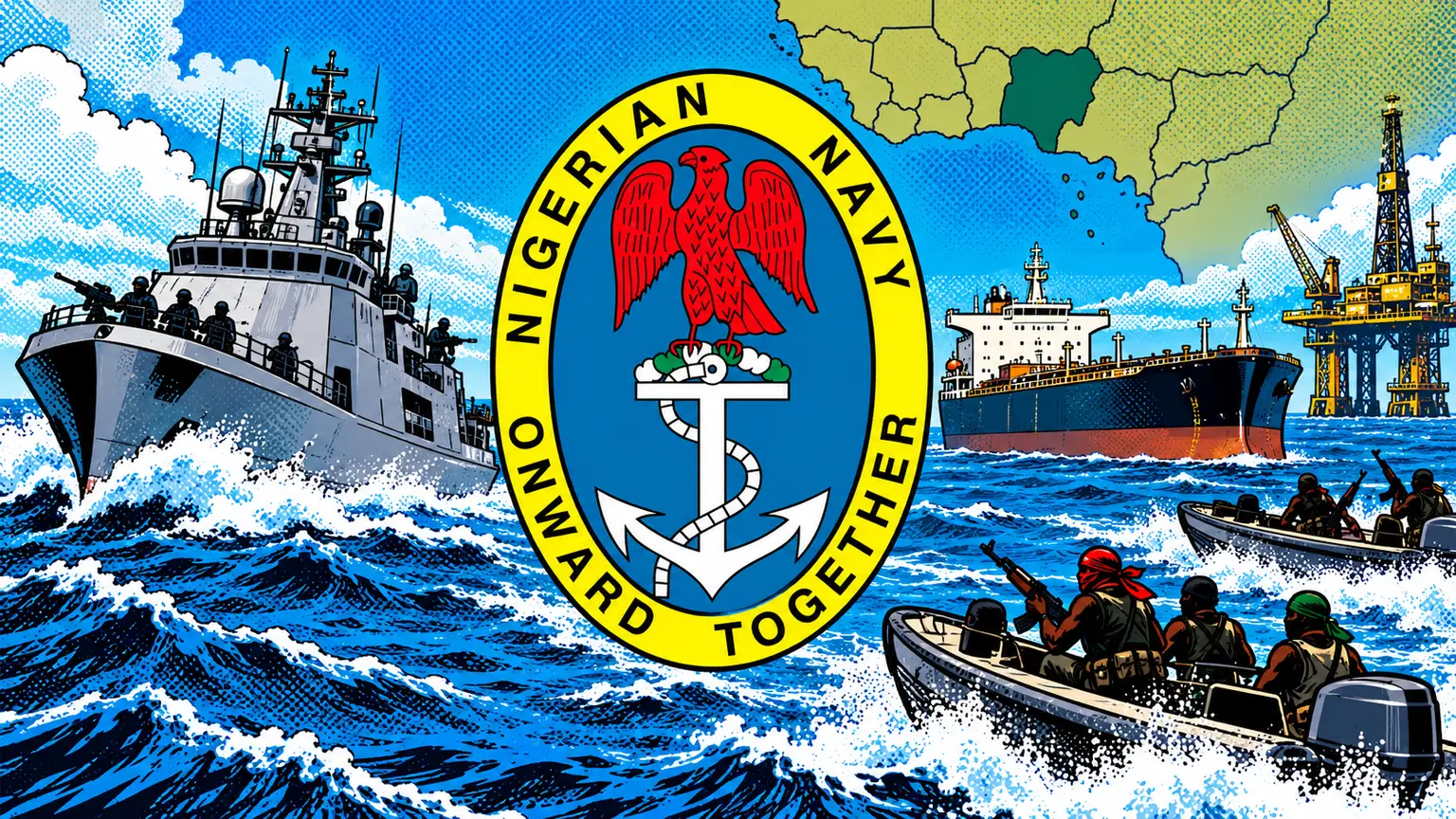
A tanker waiting off a West African port, a fishing vessel operating beyond the visible reach of coastal patrols, and an offshore production platform are not separate security problems. They sit within the same contested maritime space. Gulf of Guinea maritime security threats have shifted from headline-grabbing kidnappings at sea to a wider and more persistent challenge involving oil theft, illegal fishing, port vulnerability, criminal logistics and weak maritime governance.
For coastal states, this is not merely a law-enforcement question. The Gulf carries hydrocarbons, fisheries, ports, subsea infrastructure and sea lanes that underpin public revenue and regional trade. When control over those waters is diluted, sovereignty is diluted with it. The strategic task is therefore not simply to reduce piracy incidents, but to build the institutions, assets and regional political discipline required to govern a vast and economically vital maritime domain.
The threat has changed, not disappeared
The decline in reported piracy and kidnapping incidents since their peak should be treated carefully. It reflects a combination of national naval action, regional co-operation, industry precautions and the disruption of some criminal networks. It does not mean the conditions that enabled maritime crime have been removed.
Nigeria’s coastal waters and wider offshore approaches remain central to the region’s risk picture because of the scale of its petroleum sector, commercial traffic and the criminal economies operating in the Niger Delta. Yet the problem has always extended beyond one country. Criminal groups use jurisdictional seams, poorly monitored estuaries, informal landing sites and cross-border supply chains. A syndicate can source intelligence in one state, stage from another and dispose of stolen product through networks that reach far beyond the Gulf.
Kidnapping of seafarers remains the most visible manifestation because of its human cost and its effect on shipping decisions. But oil cargo theft, illegal bunkering, armed robbery at anchorages and piracy are better understood as connected expressions of a broader political economy. They depend on access to boats, fuel, weapons, communications, safe havens and corrupt protection. An operation at sea can be disrupted by a patrol; the network behind it requires financial investigation, prosecution and political resolve.
Why the Gulf of Guinea remains strategically exposed
The Gulf of Guinea’s security environment is shaped by geography as much as by criminal intent. Its coastline stretches across numerous sovereign jurisdictions, from West Africa into Central Africa. The sea space is vast, while many navies and coastguards operate with limited platforms, uneven maintenance cycles, thin surveillance coverage and competing domestic commitments.
This creates a basic asymmetry. Criminal operators require only a small number of fast craft, local knowledge and a reliable route back to shore. States must identify suspicious activity across large exclusive economic zones, establish legal authority, deploy vessels, sustain crews, gather admissible evidence and secure convictions. A patrol boat that cannot remain at sea, a radar feed that is not shared, or a detained suspect who is never prosecuted all weaken deterrence.
The problem is compounded by insecurity on land. In coastal areas where youth unemployment, environmental degradation and resentment over resource distribution persist, maritime criminality can become an extension of local political and economic grievances. That does not excuse it. It does explain why a narrowly naval response often produces only temporary gains.
Illegal, unreported and unregulated fishing is equally strategic. Foreign industrial fleets and local operators can exploit weak monitoring, opaque licensing and under-resourced inspection regimes. The losses are measured not only in revenue but in food security and livelihoods. As artisanal fishers face declining catches, coastal social pressures can intensify, creating conditions that criminal actors may exploit. Fisheries protection is therefore part of national security, not a secondary conservation issue.
Ports, offshore assets and the grey-zone problem
The threat also reaches beyond attacks on ships. Major ports are gateways for trade, but can also be exploited for smuggling, document fraud and movement of contraband. Offshore energy facilities require protection against sabotage, theft and unauthorised access. Undersea cables and energy infrastructure have become globally recognised strategic assets; African coastal states cannot assume that their vulnerability will remain outside the calculations of hostile or opportunistic actors.
Not every risk fits the traditional piracy model. A vessel may manipulate its tracking signal, conduct an illicit ship-to-ship transfer, enter a restricted area under a false pretext or support a network moving stolen petroleum products. These activities occupy a grey zone between commercial irregularity, organised crime and national-security exposure. They demand maritime domain awareness that combines naval intelligence, customs data, port intelligence, fisheries monitoring and commercial shipping information.
Regional architecture matters, but implementation decides outcomes
The Yaoundé Architecture remains the region’s most significant framework for maritime security co-operation. It created a structure for information-sharing and co-ordination across West and Central Africa, linking national centres with multinational zones and regional institutions. Its underlying logic is sound: threats cross maritime boundaries, so situational awareness and responses must do the same.
Its weakness is not conceptual. It is the familiar gap between architecture and operational capacity. Information centres need trained analysts, secure communications, common procedures and authority to act on what they receive. National agencies need interoperable systems and clear rules on who leads when a suspect vessel crosses an invisible line at sea. Governments must also fund the routine work that produces maritime control: maintenance, fuel, training, intelligence analysis, legal case preparation and oversight.
External partners can assist with training, surveillance systems, equipment and exercises. Such support is useful when it strengthens African command, local maintenance capacity and sovereign decision-making. It becomes less useful when donor priorities dictate procurement, data is controlled externally, or a short-term project substitutes for national investment. Maritime security assistance should leave behind durable African capability, not a dependency on visiting assets and foreign contractors.
There is also a trade-off in how states allocate scarce defence resources. High-end naval platforms carry political prestige and may be necessary for offshore deterrence, but they cannot replace coastal surveillance, maritime patrol aircraft, unmanned systems, functioning coastguard services and intelligence-led law enforcement. For many states, a layered model will offer more value: persistent awareness close to shore, capable interception assets, and selective naval reach for offshore protection and regional missions.
From presence at sea to control of the maritime economy
A credible response begins with a clear national maritime-security strategy tied to economic priorities. States should identify which ports, fishing grounds, offshore installations, cable routes and shipping approaches are most consequential, then align assets and legal authorities around them. Trying to patrol every mile equally is neither affordable nor strategically sound.
The second requirement is to make crime unprofitable. That means following stolen cargo through brokers, storage facilities, false documentation and financial channels. It means auditing licensing and contracting in the petroleum and fisheries sectors, improving transparency around vessel ownership, and protecting investigators from political interference. Arrest figures can create a useful public signal, but convictions, asset recovery and disrupted networks are the measures that alter criminal calculations.
Third, coastal communities must be treated as partners in maritime security rather than as passive terrain. Fishers, port workers and local authorities often see anomalous activity first. Reporting mechanisms, lawful livelihood protection and trust in security institutions can improve early warning. Heavy-handed enforcement that alienates communities may instead protect the very networks authorities seek to dismantle.
Finally, regional co-operation needs to move from meetings to repeatable operations. Shared threat assessments, joint patrol planning, compatible evidence procedures and rapid notification protocols are less visible than fleet acquisitions, but they are what allow states to close gaps exploited by criminal groups. The test is whether a suspicious contact detected off one coast can be tracked, intercepted and prosecuted across jurisdictions without losing the trail.
The Gulf of Guinea will remain a strategic arena because its resources and trade routes guarantee it. The practical choice for African states is whether this value will continue to attract predation, or whether it will finance the maritime institutions capable of defending it. Durable security begins when coastal sovereignty is exercised not only on maps, but through informed, accountable and sustained control at sea.



Leave a Reply