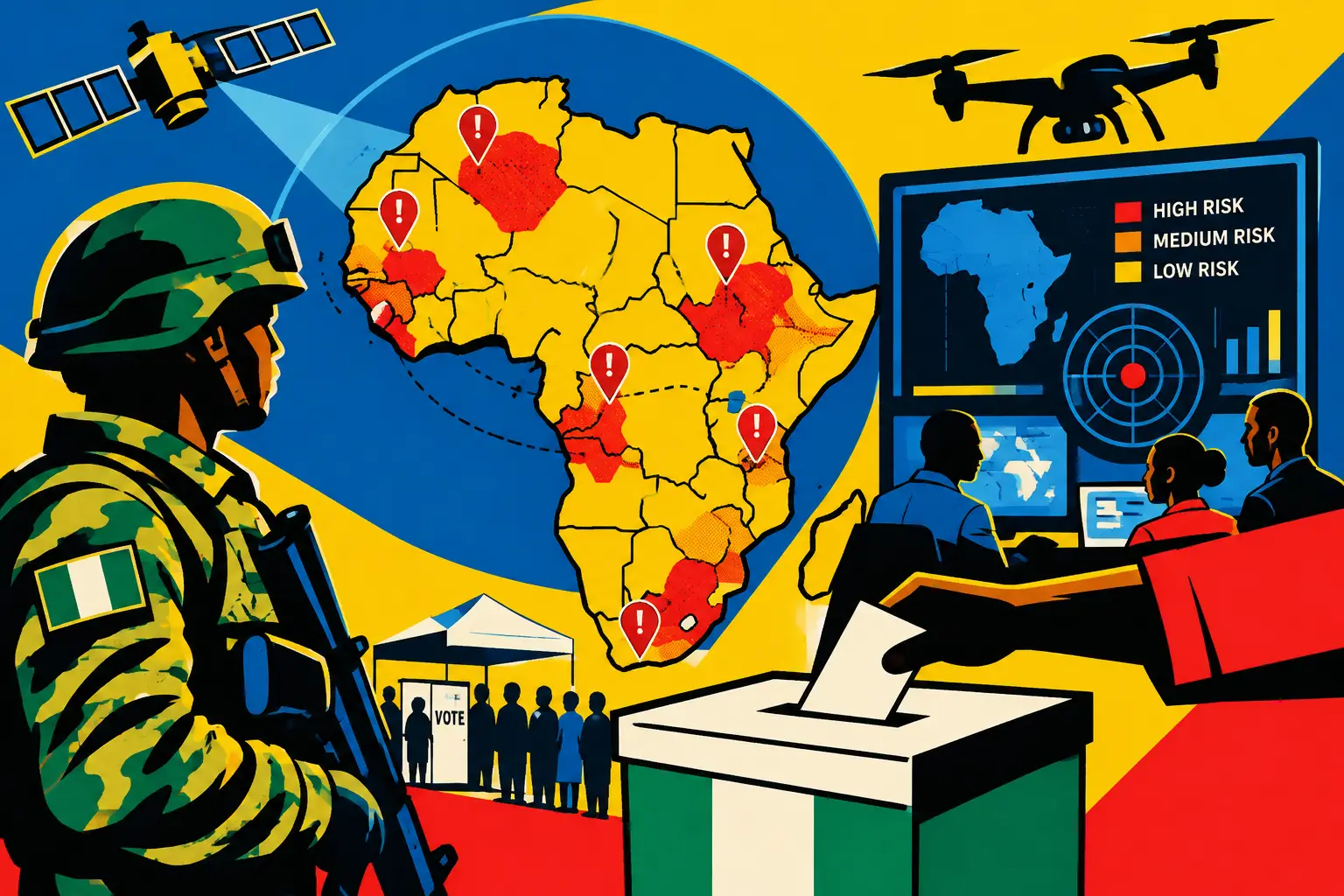
An election can be technically well administered and still become a national security crisis. A disputed result, a coordinated disinformation campaign, a regional insurgency, or an attack on communications infrastructure can turn voting day into a test of state authority. To understand how to map election security, governments and electoral bodies must look beyond ballot boxes and police deployment. They must identify the systems, actors and places through which electoral legitimacy can be weakened.
For African states, this task carries an additional strategic dimension. Elections increasingly sit at the intersection of domestic political competition, digital platform power, foreign influence, economic grievance and localised insecurity. A credible security map therefore does not merely predict violence. It shows where sovereignty, public confidence and institutional independence are exposed.
Start with the electoral system, not the threat headline
The first error in election-security planning is to begin with the most visible danger: opposition rallies, armed groups or inflammatory social-media posts. Those risks matter, but a useful map begins by identifying what must be protected. This includes voter registration data, ballot production and storage, polling stations, electoral commission offices, result-transmission networks, courts, media organisations, transport corridors and the people operating each system.
Each asset should be assessed for three questions: how critical it is to the credibility of the election, how easily it can be disrupted, and what happens if it fails. A delayed delivery of ballot papers may be a logistical problem in one district. In another, especially where political trust is already low, it may be framed as deliberate exclusion and trigger confrontation.
This distinction matters because election security is not simply about preventing attacks. It is about preventing incidents from acquiring political meaning that outstrips their operational scale.
How to map election security across time and territory
A serious map combines geography with an electoral timeline. Security risks do not emerge only on polling day. They build during voter registration, candidate nomination, campaigning, voting, result collation, judicial challenges and the transfer or retention of power.
At the geographic level, planners should separate national risk from local risk. National indicators may include inflation, elite fragmentation, hostile information activity, constitutional controversy or public distrust in the electoral commission. Local indicators are often more predictive of violence: contested administrative boundaries, unresolved land disputes, ethnic or clan competition, youth unemployment, criminal networks, refugee pressures and weak police legitimacy.
A district with no history of electoral violence may still be vulnerable if a new road, mining concession, local government boundary or population movement has altered the political balance. Conversely, an area with a record of unrest may remain calm if local mediation mechanisms are credible and political leaders have incentives to restrain supporters.
The timeline reveals when particular vulnerabilities peak. During registration, exclusion claims and data integrity are central. During campaigning, intimidation, hate speech and clashes around rallies may dominate. During collation, the most sensitive risks often concern communications outages, attacks on electoral staff, manipulated results narratives and premature declarations by political actors. The period after results is frequently decisive, because uncertainty creates space for organised mobilisation and external information operations.
Identify actors by capability, intent and access
Election maps often list stakeholders without distinguishing between those who can cause disruption and those who can contain it. The relevant question is not simply who is present, but who has the capability, intent and access to affect the process.
Political parties and candidates may mobilise supporters peacefully or deploy local brokers to intimidate rivals. Security services may deter violence, but they can also become a source of distrust if their deployment appears partisan. Criminal groups may exploit campaign finance, transport contracts or weak border controls. Armed organisations may target voting as a symbol of state presence, particularly in conflict-affected regions.
The information environment introduces another layer. Domestic influencers, diaspora networks, commercial consultancies, anonymous pages and foreign-linked media operations can all amplify narratives of fraud or repression. Not every critical post is hostile influence, and treating legitimate dissent as a security threat can deepen the crisis. The map must distinguish protected political speech from coordinated deception, incitement and impersonation.
Foreign involvement requires the same discipline. External actors may offer technical assistance, observation missions, cyber support or civic education. These can strengthen elections. Yet dependency on opaque vendors, externally hosted voter systems or politically exposed data services can create vulnerabilities that are discovered only when a dispute erupts. Mapping ownership, contractual control and data location is therefore an electoral sovereignty issue, not a technical footnote.
Map the information and communications layer
Modern election security cannot be separated from the infrastructure that carries information. Result portals, biometric devices, mobile networks, radio stations, satellite links, cloud services and messaging platforms shape both the conduct of an election and public perceptions of it.
A useful assessment traces the full chain from data collection to public communication. Who manages voter databases? Where are backups held? Which suppliers maintain election technology? How can field officials transmit results if mobile coverage fails? What is the fallback procedure if a result portal is attacked or overwhelmed? And who speaks first when false claims begin to circulate?
The answer should not be internet shutdowns. Blanket restrictions can obstruct observers, journalists, emergency services and electoral staff while feeding suspicion that authorities are concealing manipulation. They also impose economic costs and establish a damaging precedent. More targeted measures, grounded in law and subject to independent oversight, are usually more defensible than shutting down the public information space.
Resilience comes from redundancy and transparency. Paper audit trails, offline contingency procedures, independently tested systems, clear incident reporting and prompt public explanations can reduce the political value of technical disruption. A system need not be invulnerable to remain credible. It must be able to demonstrate how it detects, contains and corrects failure.
Build scenarios, not a single prediction
Election security maps fail when they present a static ranking of high-, medium- and low-risk areas. Risk is dynamic. One assassination, court ruling, fuel shortage, military incident or viral falsehood can shift the operating environment within hours.
Scenario planning forces institutions to prepare for plausible combinations of events. For example, a contested tally in an urban stronghold may coincide with a mobile-network outage and calls for protests. Another scenario may involve attacks on rural polling sites by armed groups, followed by claims that displaced voters were disenfranchised. A third may concern a cyber intrusion that does little direct damage but exposes personal data and erodes confidence in the electoral commission.
For each scenario, define warning indicators, decision thresholds, responsible institutions and public communication lines. The point is not to predict the future perfectly. It is to reduce hesitation when pressure is greatest.
Protect legitimacy as a security asset
Military and police deployments can secure routes, facilities and personnel, but force alone cannot secure acceptance of an outcome. Excessive or politically uneven deployment can make an election appear controlled rather than protected. The appropriate security posture depends on the threat environment, yet it should remain proportionate, lawful and visibly impartial.
That requires coordination between electoral commissions, police, intelligence services, courts, telecommunications regulators, local authorities, civil society and the media. Coordination does not mean placing the election under security-service control. Electoral bodies must retain their constitutional independence, while security institutions provide clearly defined support.
Trust is strengthened when rules are published before a crisis, observers can verify procedures, parties have access to lawful complaint channels, and officials communicate uncertainty honestly. A delayed result is less dangerous when citizens understand why it is delayed and how verification is being carried out.
Turn the map into an operational instrument
A map that remains in a briefing folder has limited value. It should drive decisions on staffing, transport, protection, monitoring, public communication and contingency funding. High-risk areas may need more trained electoral officials, protected storage, alternative routes, locally trusted mediators and rapid-response investigation teams. Digital risks may require supplier audits, tabletop exercises and independent penetration testing before the campaign period begins.
The map should also be updated through structured reporting from district officials, community leaders, journalists, civil-society monitors and security agencies. Information must be tested, not merely collected. Rumour, partisan allegation and intelligence assessment should never be treated as equivalent evidence.
The central discipline is to treat election security as a national resilience problem. When institutions map vulnerabilities early, communicate clearly and preserve their independence under pressure, they deny armed actors, political spoilers and external manipulators the instability they seek. The most valuable outcome is not a heavily guarded vote, but a public that can see its political will survive scrutiny, disruption and contestation.


Leave a Reply