

For centuries, national power was relatively easy to recognise. It marched in uniform, sailed in battleships and was measured in territory, industrial production, money and weapons. The strongest states were those capable of defeating enemies, controlling trade routes and compelling weaker countries to accept their demands.
But modern geopolitics is more complicated. A Hollywood film, university scholarship, smartphone, football club, development project or popular music genre can sometimes achieve what an aircraft carrier cannot: make millions of people voluntarily admire, trust or emulate another society.
This distinction lies at the heart of hard power and soft power.
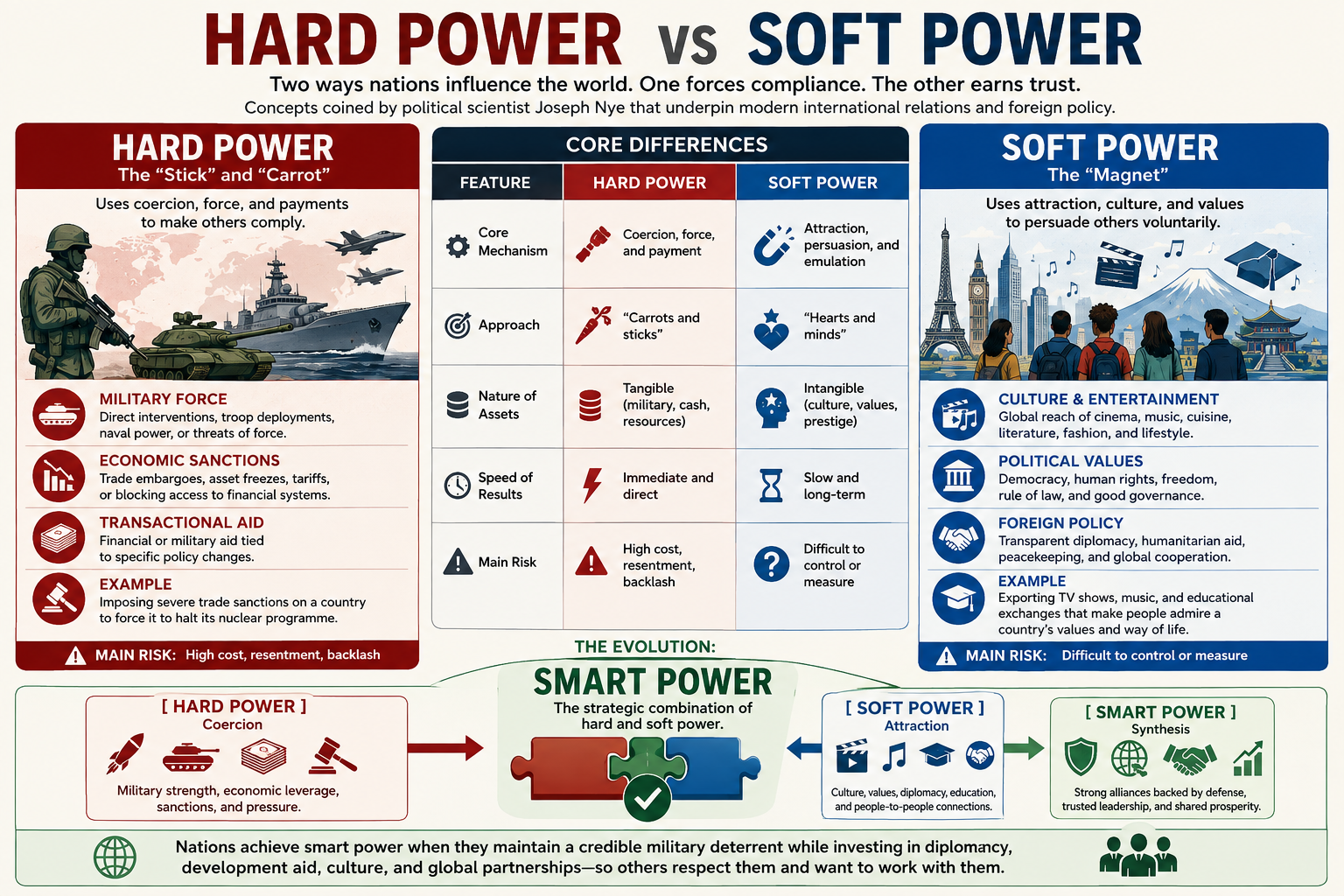
The late Harvard political scientist Joseph Nye, who developed the concept of soft power around the end of the Cold War, described power broadly as the capacity to obtain desired outcomes. Countries can influence others through coercion, payment or attraction. The first two broadly constitute hard power; attraction forms the basis of soft power.
Understanding the difference has become essential in an increasingly multipolar world in which the United States, China, Russia, India, the European Union, Gulf states and emerging powers compete simultaneously for military advantage, investment, markets and public opinion.
Hard power: making another country calculate the cost
Hard power is the most traditional expression of international power.
Its ultimate instrument is military force.
Armies, missiles, nuclear weapons, aircraft carriers, military bases and defence alliances matter because they can impose unacceptable costs on an adversary. Yet military action is only one dimension.
Economic coercion can be equally powerful. Sanctions, tariffs, financial restrictions, export controls, asset freezes and exclusion from important markets or payment systems can pressure governments without a single shot being fired.
Hard power therefore operates largely through carrots and sticks.
The message can be positive — change your behaviour and receive investment, weapons, preferential trade or financial assistance — or negative: refuse and face sanctions, isolation or potentially military action.
Its great advantage is immediacy.
If a country faces invasion, cultural diplomacy will not stop advancing tanks. Governments require armed forces and credible deterrence. Likewise, access to a sufficiently important market can give governments enormous negotiating leverage.
But hard power contains an inherent weakness.
Coercion may produce compliance without producing loyalty.
A weaker government may accept another country’s demands because it has no alternative while simultaneously resenting the country imposing them. Once circumstances change, that compliance can disappear.
Military power can destroy infrastructure relatively quickly. Building political legitimacy afterwards may take decades.
Soft power: making others want what you want
Soft power reverses the equation.
Instead of asking, “How can I force you to do this?”, it asks, “How can I make my society, policies or objectives attractive enough that you voluntarily move in my direction?”
Nye defined soft power around attraction rather than coercion or payment, with culture, political values and foreign policies among its principal resources.
The United States historically provides perhaps the clearest example.
America’s global influence has never rested solely upon the Pentagon.
Hollywood films, jazz, hip-hop, universities, Silicon Valley, consumer brands and the mythology surrounding the “American Dream” helped create an image of the United States that reached far beyond Washington’s formal alliances.
During the Cold War, this distinction mattered enormously. Nye later contrasted Western attraction with occasions when the Soviet Union needed direct military intervention to maintain control within its sphere.
Japan demonstrates another model.
Its constitution and post-war history limited the country’s traditional military profile for decades, yet Japanese automobiles, electronics, anime, manga, cuisine, architecture and popular culture created extraordinary international visibility.
That cultural attraction has economic consequences.
People who admire Japanese culture may become more interested in visiting Japan, studying Japanese, buying Japanese products or developing favourable attitudes towards the country itself.
South Korea has similarly transformed entertainment into geopolitical capital through K-pop, television dramas, cinema, cosmetics and technology.
Soft power does not require audiences to consciously think they are participating in geopolitics.
That is precisely why it can be so effective.
China enters the attraction contest
China’s rise illustrates why major powers increasingly recognise that economic and military strength alone are insufficient.
Beijing has invested in universities, international broadcasting, cultural programmes, infrastructure partnerships and diplomatic engagement while Chinese companies, technology and consumer products have expanded internationally.
The 2026 Brand Finance Global Soft Power Index placed China second globally. The United States remained first, but China surpassed America on numerous individual reputation attributes.
That matters because geopolitical competition increasingly concerns perceptions as much as physical capabilities.
When countries in Africa, Asia or Latin America decide whose infrastructure financing to accept, whose universities to attend, whose technology to purchase or whose diplomatic position to support, reputation can become a strategic asset.
The competition between Washington and Beijing therefore cannot be understood simply by counting aircraft carriers.
Soft power can be destroyed
Unlike an army or foreign-exchange reserve, soft power is unusually difficult for governments to control.
A government can purchase weapons.
It cannot simply order foreigners to admire it.
Credibility is crucial. If a country’s behaviour appears fundamentally inconsistent with the values it promotes abroad, its attractiveness can decline.
This produces what might be called the soft-power paradox: excessive use of hard power can weaken the very influence that military strength is intended to protect.
Wars, controversial sanctions, civilian casualties, diplomatic bullying or perceived double standards can transform admiration into distrust.
There is contemporary evidence of such volatility. Brand Finance’s 2026 index still ranked the United States first globally, but its score fell 4.6 points, the largest decline among the 193 countries measured, while its reputation ranking dropped sharply.
Military superiority therefore does not automatically produce political admiration.
The limits of soft power
Soft power should not be romanticised either.
Culture cannot solve every security problem.
A country may adore American films while opposing American foreign policy. Millions may watch Korean dramas without supporting Seoul diplomatically. People can enjoy Japanese anime while knowing almost nothing about Japanese politics.
Attraction also takes years to develop and can be difficult to translate into a specific diplomatic outcome.
Most importantly, soft power offers little immediate protection against direct military attack.
A country possessing enormous cultural prestige but incapable of defending its territory remains strategically vulnerable.
That is why serious states rarely choose exclusively between hard and soft power.
They combine them.
Smart power: the strategic middle ground
Nye’s broader framework ultimately produced the concept of smart power — combining hard and soft instruments intelligently rather than treating them as competing ideologies. Harvard’s summary of Nye’s work describes smart power specifically as a mixture of hard- and soft-power strategies.
Consider an alliance.
Military commitments provide hard-power deterrence. Diplomatic consultation creates trust. Trade provides economic incentives. Student exchanges create personal relationships. Cultural interaction builds familiarity.
Together, these instruments can produce influence far greater than any one of them individually.
Japan offers an interesting contemporary example. The Lowy Institute’s 2025 Asia Power Index described Japan as a “quintessential smart power” because it converts comparatively limited resources into broad diplomatic, economic and cultural influence.
This points towards perhaps the most important lesson.
Power is not merely what a country possesses. It is what the country can persuade others to do with it.
A state can possess enormous armed forces and still struggle to achieve its political objectives. Another can have a relatively modest military footprint but exercise disproportionate international influence through trade, technology, diplomacy and culture.
Africa and the next competition for influence
This distinction has particular significance for Africa.
The continent increasingly sits at the intersection of competing power centres seeking markets, minerals, diplomatic support and strategic access.
Western countries retain significant educational, financial and cultural influence. China has expanded through trade and infrastructure. Türkiye has developed commercial, diplomatic and cultural networks. Gulf states increasingly combine investment with diplomacy.
The result is a marketplace of influence.
African governments consequently possess greater opportunities to negotiate among competing partners rather than automatically entering a single geopolitical camp.
Nigeria itself possesses considerable unrealised soft-power potential.
Nollywood, Afrobeats, literature, fashion, cuisine and the Nigerian diaspora reach audiences that conventional diplomacy could never reproduce.
The strategic question is whether that cultural influence can be converted into sustained economic and diplomatic leverage.
The power to attract
Hard power ultimately asks:
What can I make you do?
Soft power asks:
What can I make you want?
The strongest countries understand that both questions matter.
Aircraft carriers can protect shipping lanes. Sanctions can punish adversaries. Economic assistance can influence governments.
But none automatically creates legitimacy.
Universities, businesses, music, films, technology, political credibility and culture can build relationships lasting generations — but they cannot substitute completely for economic resilience and national defence.
The emerging international system will therefore not necessarily belong simply to the country possessing the most missiles or the largest economy.
It may favour those states capable of converting military strength, economic weight, diplomatic credibility and cultural attraction into a coherent strategy.
That is smart power.
And in the increasingly crowded contest for global influence, knowing when not to use force may become as important as possessing the ability to use it.
Majemite Jaboro writes for DWA


Leave a Reply