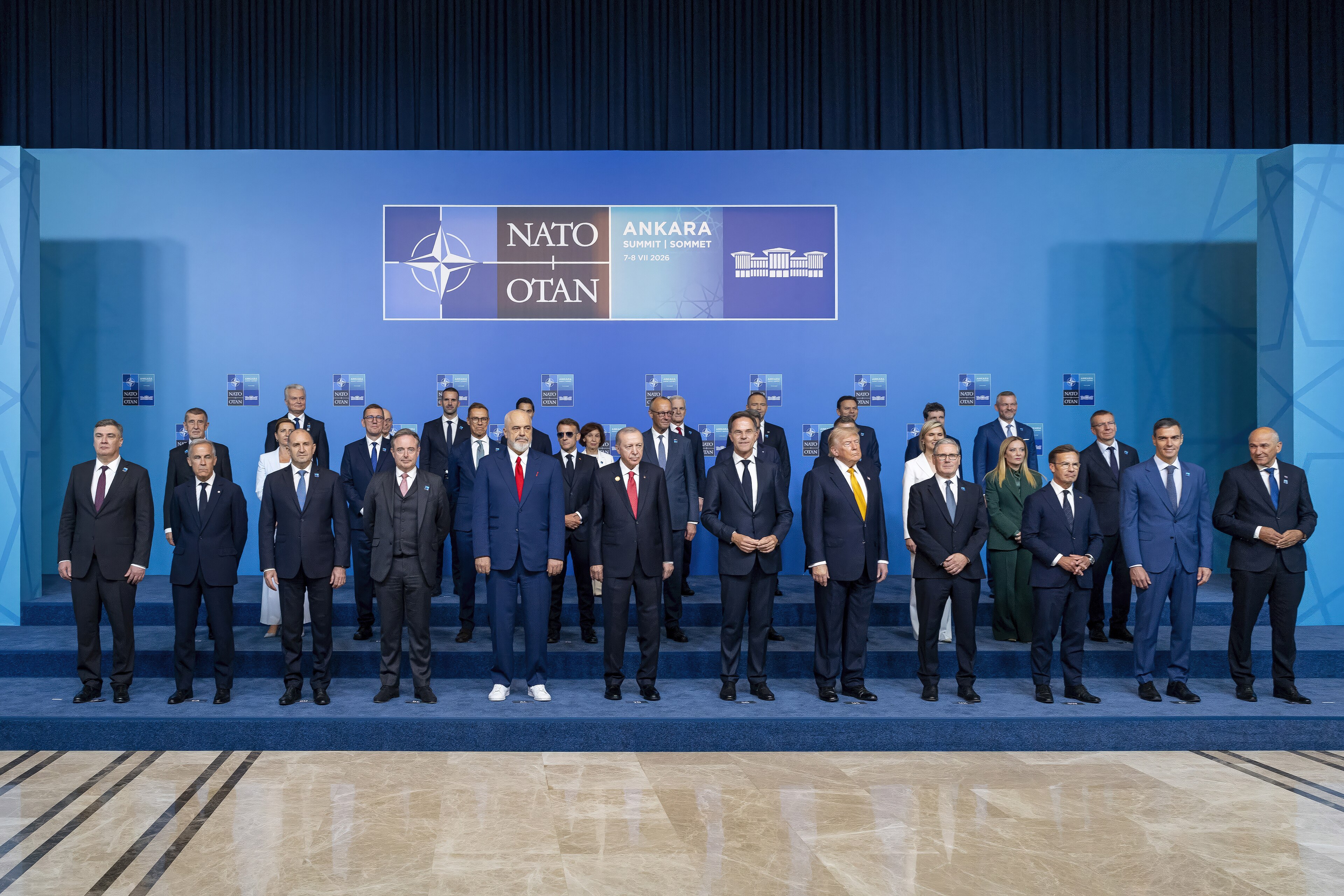

For most of the period since Russia’s full-scale invasion of Ukraine, NATO’s strategic geography has appeared overwhelmingly eastern. Poland, the Baltic states, Finland and the Black Sea became central to an alliance rebuilding its conventional deterrence against Moscow.
But NATO’s security problem increasingly extends in the opposite direction.
Across the Mediterranean, North Africa, the Sahel and Middle East, collapsing states, insurgencies, migration pressures and competition involving Russia and China are creating a second strategic arc. NATO increasingly describes its response as a 360-degree approach: deterrence on the eastern flank must coexist with security engagement to the south.
The shift is important for Africa because NATO’s southern strategy is not principally about extending Article 5 to African countries or deploying large armies across the Sahel. It is about ensuring instability south of Europe does not translate into strategic vulnerability inside Europe.
That distinction will define NATO-African relations through the remainder of the decade.
Why NATO Is Looking South
The southern neighbourhood is enormous.
A 2026 European Parliament briefing describes a strategic space extending through North Africa and the Middle East and increasingly interconnected with developments in the Sahel.
For NATO, several security problems overlap within this geography.
Jihadist organisations continue operating across parts of the Sahel. Libya remains politically divided. Sudan’s conflict has generated another zone of instability. Maritime routes through the Mediterranean, Red Sea and approaches to the Suez Canal have become increasingly exposed to geopolitical disruption.
Migration, arms trafficking and organised crime cross these regions without respecting national boundaries.
The result is that Europe’s southern security environment can no longer be treated as separate from African security.
Russia Changes the Equation
Russia represents the most immediate geopolitical component of NATO’s southern calculations.
Moscow has expanded relationships across the Sahel as several governments reduced security cooperation with France and other Western countries. Russian personnel associated with the Africa Corps and predecessor Wagner structures have operated in countries including Mali and Libya, while Moscow has pursued security relationships elsewhere across the continent.
For Russia, Africa provides more than diplomatic influence.
Access to governments, airfields, ports and mineral resources can extend Russian strategic reach while simultaneously reducing Western influence.
That creates an unusual geographical challenge for NATO.
Russia can now potentially exert pressure against the alliance from both east and south.
This does not mean Russian forces in Africa represent anything comparable with Russia’s military concentration in Europe. But they create intelligence, diplomatic and access opportunities that NATO planners cannot ignore.
China Presents a Different Challenge
China’s African strategy is fundamentally different.
Beijing has generally avoided Russia’s model of direct participation in African conflicts. Instead, Chinese influence is built through infrastructure, military education, defence exports, telecommunications and commercial investment.
The People’s Liberation Army’s support base in Djibouti represents the clearest military manifestation.
But ports, communications networks and other dual-use infrastructure potentially provide China with strategic options extending well beyond Djibouti.
For NATO, therefore, Russia and China represent different southern challenges.
Russia often exploits immediate security vacuums.
China builds long-term structural influence.
The Western concern is that both trends reduce Europe’s strategic freedom across a region immediately beyond NATO territory.
Italy Becomes NATO’s Southern Anchor
Geography places Italy at the centre of the response.
Italy sits between continental Europe, North Africa and the eastern Mediterranean. Its ports, naval facilities and command infrastructure make it a natural hub for NATO’s southern operations.
Naples already hosts Allied Joint Force Command Naples, while the NATO Strategic Direction-South Hub operates from the same city.
NATO Strategic Direction-South Hub
Established in 2017, the Hub was designed to improve NATO’s understanding of developments across the Middle East and Africa. Rather than functioning simply as a conventional military intelligence headquarters, it engages with governments, researchers, civil society and international organisations to assess issues ranging from terrorism and governance to climate pressures and human security.
Italian facilities such as Taranto also have increasing significance as NATO strengthens its ability to operate across the Mediterranean.
The southern strategy consequently begins not in the Sahel but on NATO’s own Mediterranean coastline.
The Mediterranean Returns to Military Importance
For decades after the Cold War, Western naval dominance in the Mediterranean was largely taken for granted.
That assumption is becoming less comfortable.
Russia retains significant maritime interests in the Mediterranean, although the changing political situation in Syria has complicated Moscow’s previous basing arrangements. China maintains a growing blue-water naval capability and substantial commercial interests throughout the region.
Meanwhile, instability surrounding the Red Sea and Middle East has demonstrated how quickly conflict can disrupt international shipping.
The Mediterranean is therefore returning to its historical role as a strategic corridor connecting Europe, Africa and Asia.
NATO’s southern strategy will increasingly involve maritime surveillance, submarine detection, protection of critical infrastructure and monitoring of shipping routes rather than simply conventional fleet deployments.
The Sahel Security Vacuum
The greatest political difficulty lies farther south.
France’s retreat from much of the Sahel fundamentally changed the region’s security architecture.
Western counter-terrorism operations were unable to eliminate jihadist insurgencies, while military governments in Mali, Burkina Faso and Niger increasingly rejected the previous French security model.
Russia moved rapidly into parts of that vacuum.
NATO faces a dilemma.
Directly replacing France would risk repeating precisely the intervention model that became politically toxic.
Ignoring the Sahel would create additional space for jihadist organisations, Russian security relationships and potentially other external actors.
The emerging solution is therefore likely to emphasise partnerships rather than occupation.
Training, intelligence sharing, maritime security, counter-terrorism expertise and military education provide NATO with ways to influence regional security without creating another large Western expeditionary footprint.
Migration Is a Security Issue—but Not a Military Problem
Migration inevitably features prominently in European discussions of the southern flank.
Instability in the Sahel and North Africa can contribute to population movements towards the Mediterranean.
But NATO must be careful.
Treating migration itself as a military threat risks confusing humanitarian and political problems with defence policy.
The alliance can contribute maritime surveillance and intelligence against human-trafficking networks. It cannot resolve the economic and governance conditions driving migration.
This distinction matters particularly for African governments, which are unlikely to welcome a NATO strategy appearing primarily designed to prevent Africans reaching Europe.
A credible southern policy therefore needs to offer African partners something beyond European border protection.
The Partnership Model
This explains NATO’s emphasis on cooperation rather than enlargement.
The alliance already maintains the Mediterranean Dialogue with countries including Algeria, Egypt, Jordan, Mauritania, Morocco and Tunisia, alongside its Istanbul Cooperation Initiative with Gulf partners.
Science and technology programmes provide another channel.
NATO’s Science for Peace and Security Programme supports cooperation involving cyber defence, counter-terrorism, emerging technologies and other security challenges with partner countries. NATO Science for Peace and Security Programme
These mechanisms reveal the likely character of NATO’s southern expansion.
It will probably be institutional rather than territorial.
NATO’s Internal Divide
The strategy nevertheless contains a fundamental political contradiction.
Eastern NATO members understandably view Russia as the overriding threat.
For Poland and the Baltic states, resources diverted towards Mediterranean security can appear to weaken the alliance’s most urgent deterrence mission.
Southern members see the equation differently.
Italy, Spain and other Mediterranean states experience instability across North Africa and the Middle East much more directly.
NATO must therefore maintain two strategic fronts without allowing either to believe the other is consuming disproportionate resources.
The Ukraine war makes that balancing act considerably harder.
Africa Is Not Waiting for NATO
There is another problem.
African states have considerably more strategic choice than they did during the Cold War.
Turkey has become an increasingly important defence supplier.
China provides weapons, infrastructure and military education.
Russia offers security partnerships without Western political conditionality.
Gulf states are expanding investments and diplomatic influence.
African governments therefore do not necessarily see their security choices through NATO’s Russia-versus-West framework.
Many will cooperate simultaneously with Western, Chinese, Turkish and Russian partners.
Attempting to force binary alignment could consequently undermine NATO’s strategy.
The Gaza Problem
Western credibility also matters.
The war in Gaza has significantly complicated Western diplomacy across the Arab world and parts of Africa.
Governments and populations that perceive inconsistency between Western positions on Ukraine and Palestine are less receptive to arguments about a Western-led “rules-based international order.”
NATO cannot solve that political contradiction militarily.
But it must operate within its consequences.
Southern strategy therefore requires diplomacy at least as much as military capability.
The African Perspective
Africa should also approach NATO’s renewed attention cautiously.
Greater Western engagement could produce useful military training, intelligence cooperation, maritime surveillance and counter-terrorism capabilities.
But African governments should resist becoming another arena for great-power confrontation.
The continent’s strategic objective should be diversification.
African states can cooperate with NATO while purchasing Turkish drones, maintaining Chinese infrastructure relationships and pursuing other security partnerships where national interests require them.
Strategic autonomy means refusing to become exclusively dependent upon any external bloc.
Strategic Outlook
NATO’s southern strategy represents recognition that European security no longer ends at the Mediterranean shoreline.
Instability in Libya and the Sahel, Russian security expansion, Chinese infrastructure influence, terrorism and maritime disruption increasingly connect African developments directly to European defence planning.
But NATO faces a fundamental choice.
It can approach Africa primarily as a source of threats—migration, terrorism and Russian influence—or treat African states as strategic partners with their own interests.
The first approach risks repeating the mistakes that contributed to declining Western influence across the Sahel.
The second requires accepting that African governments will not necessarily choose between NATO, China and Russia.
For DWA readers, that is the central strategic shift.
NATO is looking south because Africa has become too important to European security to remain strategically peripheral. But Africa is simultaneously becoming too geopolitically independent for NATO to dictate the terms of engagement.
The success of the alliance’s southern strategy will therefore depend less upon how much military power NATO can project across the Mediterranean than upon whether it can build partnerships that African governments themselves consider worth maintaining.
Majemite Jaboro writes for DWA

Leave a Reply