
Iran is entering perhaps the most dangerous economic phase of its confrontation with the United States. Washington’s strategy increasingly resembles a war of financial and maritime attrition: restrict Iranian oil exports, isolate its banks, close alternative trading routes and force Tehran to choose between economic exhaustion and political concessions.
The pressure is becoming severe.
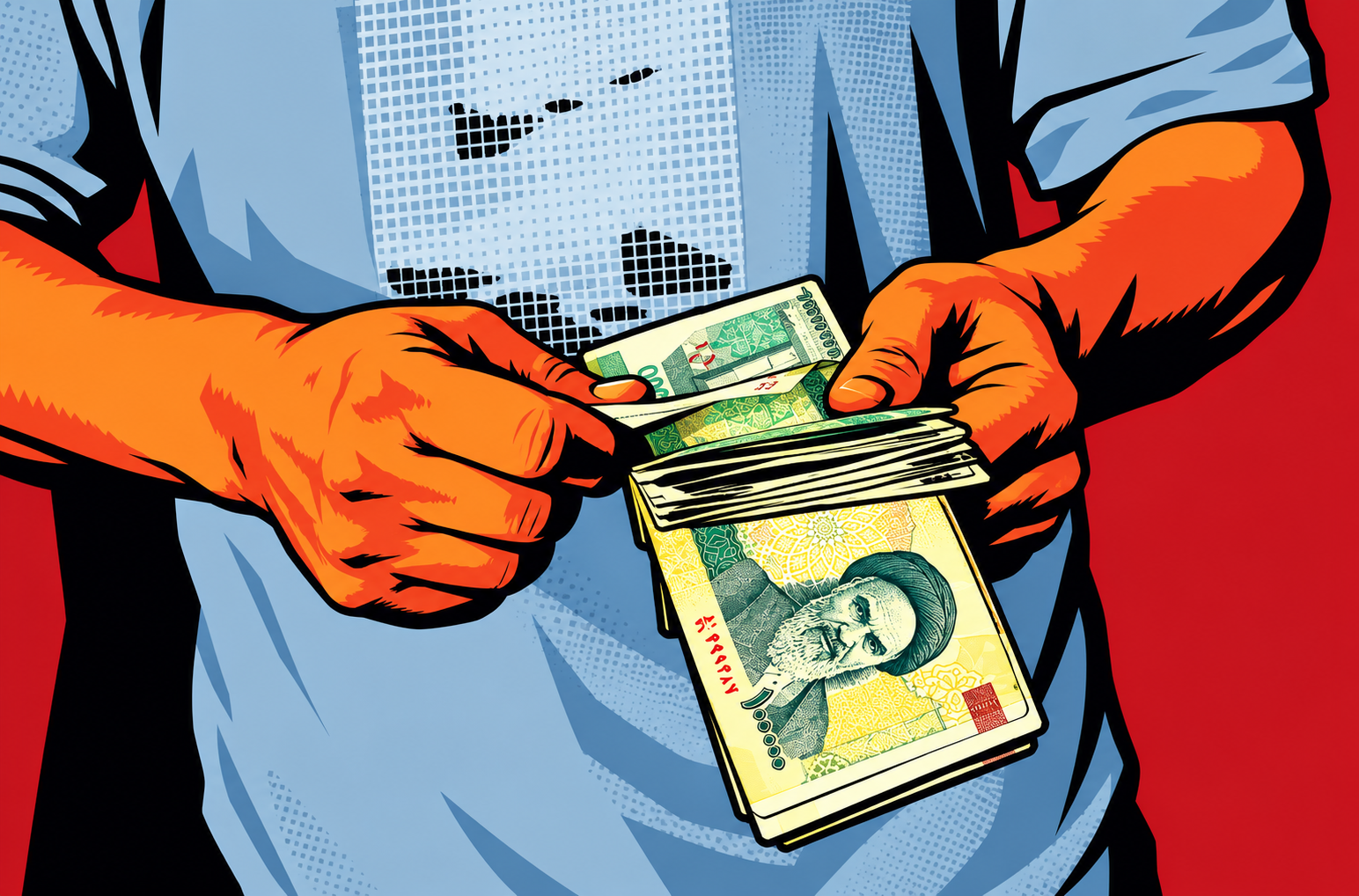
Iran’s rial fell to around 2.69 million to the dollar on October 3, having lost more than half its value over the previous year, while inflation has climbed above 70 percent. Tehran’s central bank has responded by making up to $2 billion available to support the currency. Meanwhile, the American naval blockade has severely restricted the oil exports that traditionally provide Iran with foreign exchange.
Yet economic strangulation does not automatically mean strategic defeat. Iran’s survival now depends upon whether it can transform an economy built around exporting hydrocarbons for internationally convertible currency into a wartime economy capable of functioning increasingly outside the Western financial system.
The first battlefield is therefore not the Strait of Hormuz.
It is the monetary system.
Breaking the Dollar Dependency
Iran’s immediate objective should be reducing the importance of the dollar itself.
Tehran cannot defeat American financial power while continuing to measure its economic survival primarily through access to dollars. Washington’s greatest economic weapon is not the aircraft carrier but its influence over the international financial architecture surrounding dollar transactions.
Iran therefore has a powerful incentive to expand trade denominated in Chinese yuan, Indian rupees and Russian rubles, alongside bilateral clearing arrangements and barter.
China is particularly important. Even American assessments describe China as Iran’s most important economic lifeline, especially because of its role in purchasing Iranian petroleum.
The yuan consequently offers Tehran something more important than symbolism: access to the economy of Iran’s largest potential trading partner.
Iran could increasingly price Chinese exports and imports directly in yuan, maintain yuan reserves and use Chinese currency for purchases from participating Asian suppliers. Similar arrangements involving rubles could support Russian-Iranian trade.
India represents another potentially important component. Rupee settlement mechanisms would allow Iranian exports to finance imports of Indian food, pharmaceuticals, industrial products and other goods without transactions necessarily being converted first into dollars.
None of these currencies can individually replace the dollar globally.
They do not need to.
Iran only needs enough alternative settlement capacity to keep essential trade functioning.

Build a Continental Economy
The blockade creates another strategic imperative: Iran must become less dependent upon maritime exports.
American pressure is already moving in this direction. Iran has increasingly relied upon alternative land transportation, including rail connections with China. Cargo trains between Xi’an and Tehran reportedly increased after the blockade began. Washington has responded by extending sanctions pressure to Iranian railway companies, illustrating how important overland commerce has become.
This contest could become one of the decisive economic struggles of the war.
Iran sits geographically between Central Asia, the Caucasus, the Middle East and South Asia. Its long-term answer to maritime containment therefore lies partly in transforming itself into a continental trading economy.
Rail and road connections through Central Asia towards China, northwards towards Russia and eastwards towards Afghanistan and Pakistan cannot replace unrestricted maritime commerce. Their capacity is considerably smaller and transportation costs are higher.
But wartime economics is about resilience rather than efficiency.
A railway carrying machinery, medicines, industrial components or food into Iran matters precisely because an American destroyer cannot blockade a railway hundreds of kilometres inland.
Protect the Domestic Economy
De-dollarisation abroad will accomplish little if confidence collapses at home.
The rial’s depreciation demonstrates the danger. Ordinary Iranians attempting to preserve their savings naturally move towards dollars, gold and other stores of value when inflation accelerates. That creates a vicious cycle: expectations of depreciation generate demand for foreign currency, which produces additional depreciation.
Tehran therefore needs more than central-bank intervention.
It needs economic credibility.
Foreign currency should be prioritised for food, medicines, industrial inputs, agricultural equipment and strategically important manufacturing rather than non-essential imports. Government expenditure would have to increasingly resemble wartime budgeting, with subsidies concentrated on basic necessities and vulnerable households.
Iran must simultaneously protect domestic productive capacity.
An economy under blockade survives when goods that can no longer be imported are increasingly produced domestically or sourced from politically reliable trading partners.
The strategic objective is not prosperity under blockade.
It is preventing economic pressure from translating into social and political breakdown.

Hormuz: Iran’s Dangerous Economic Weapon
Iran retains another source of leverage: geography.
The Strait of Hormuz remains one of the most strategically important waterways on Earth. Recent attacks demonstrate how vulnerable maritime commerce remains. Britain’s UK Maritime Trade Operations reported tankers struck by unidentified projectiles around the Strait in late September and early October. Responsibility for those particular incidents had not been established in the UKMTO notices.
Iranian forces have previously attacked shipping during the current conflict, while the United States has attacked Iranian vessels in response.
For Tehran, however, attacks on commercial shipping represent an extraordinarily dangerous form of leverage.
Disruption can increase shipping insurance costs, complicate American naval operations and put upward pressure on global energy prices. But indiscriminate pressure on international shipping can also alienate precisely the Asian and Gulf states Iran needs economically.
China and India need affordable energy and predictable shipping.
Iran therefore faces a fundamental contradiction: the more effectively instability in Hormuz damages the world economy, the greater the potential damage to Iran’s own remaining trading relationships.
The Strait is consequently more valuable to Tehran as negotiating leverage than as a permanently closed waterway.
Confronting the U.S. Navy
The same calculation applies even more strongly to direct confrontation with American warships.
Iran possesses the ability to impose costs on U.S. military operations, and Washington clearly takes that threat seriously. But attacking American naval vessels risks producing exactly the escalation Tehran needs to avoid: a vastly expanded American air and maritime campaign.
The latest American deployments are therefore significant.
The Pentagon is sending the USS Theodore Roosevelt towards the region alongside the USS Makin Island Amphibious Ready Group. Around 2,200 Marines from the 13th Marine Expeditionary Unit are associated with the latter deployment, while reporting indicates the broader reinforcement could add roughly 9,000–10,000 American personnel.
Two American carriers are already operating in Middle Eastern waters, meaning three carriers could temporarily overlap.
This is formidable combat power.
But three carriers do not automatically mean an invasion.
Aircraft carriers are primarily instruments of air power and sea control. The presence of an amphibious ready group and Marines provides Washington with additional options ranging from evacuation and maritime-security missions to raids and limited amphibious operations.
A full-scale ground invasion of Iran would require an enormously larger logistical architecture.
The more defensible conclusion is therefore that Washington is building optionality.
It wants the ability to intensify military operations rapidly if diplomacy fails.
The Midterm Clock
This creates an important political timetable.
The U.S. midterm elections take place on November 3, 2026. Reporting indicates that the domestic political consequences of the Iran conflict—including energy prices—are influencing Washington’s calculations. The Wall Street Journal has reported that President Trump is considering whether to resume heavier bombing after the midterms.
Iran therefore has an incentive to intensify diplomacy before that political window closes.
But Tehran should not assume Washington will remain militarily constrained until election day. A major attack causing substantial American casualties could overturn those calculations immediately.
Iran’s strongest pre-election strategy may consequently be political-economic rather than purely military: survive the blockade, preserve enough leverage in Hormuz to remain indispensable to negotiations, deepen economic relations with China, Russia and other non-Western states, and make a negotiated settlement economically preferable to indefinite confrontation.
Diplomacy Must Become Part of the War Economy
Iran ultimately cannot trade its way completely around a maritime blockade backed by secondary sanctions.
Its economic strategy therefore needs a diplomatic component.
Tehran should seek to transform the dispute from an American-Iranian confrontation into an international argument over freedom of trade, energy security and the legitimacy and consequences of economic coercion.
China is indispensable. Russia matters. India matters. Türkiye, Oman, Iraq, Pakistan and the Gulf monarchies matter.
The objective would not necessarily be persuading these states to become Iranian allies.
It would be persuading them that permanent economic warfare in the Persian Gulf is against their own interests.
Recent diplomacy has so far failed to produce a settlement. Analysis following meetings around the UN General Assembly concluded that Washington and Tehran still believe they possess sufficient leverage to demand substantial concessions from the other.
That mutual confidence is dangerous.
Survival Is Victory
Iran does not need to economically defeat the United States.
It needs to deny Washington the ability to translate economic pressure into Iranian capitulation.
That requires a fundamentally different definition of victory.
Oil exports may remain constrained. The rial may remain weak. Growth may suffer severely. Imports may become expensive and living standards could deteriorate.
But if Iran maintains essential imports, preserves domestic production, develops yuan-, rupee- and ruble-based commerce, expands overland trade and keeps China, Russia, India and neighbouring states economically engaged, the blockade becomes progressively more expensive to sustain politically and strategically.
The greatest Iranian mistake would be confusing escalation with leverage.
Destroying commercial shipping or inflicting American casualties could create enormous economic shock—but it could equally provide Washington with the political justification for a much larger military campaign.
The arrival of another carrier therefore should not be read simply as evidence that ground war is inevitable.
It should be read as a warning that the strategic window is narrowing.
Iran’s most powerful response is not necessarily to match American military power ship for ship. That is impossible.
It is to make economic isolation fail.
Move trade eastward. Diversify currencies. Expand continental transport corridors. Protect essential domestic consumption. Preserve Hormuz as bargaining leverage. Intensify diplomacy with Beijing, Moscow, New Delhi and regional capitals.
And above all, survive.
Because in a prolonged war of economic attrition between two profoundly unequal military powers, Iran does not have to break the blockade overnight to achieve its strategic objective. It has to remain economically and politically functional long enough for the costs of maintaining that blockade to change the calculations of everyone around it.
Majemite Jaboro writes for DWA

Leave a Reply