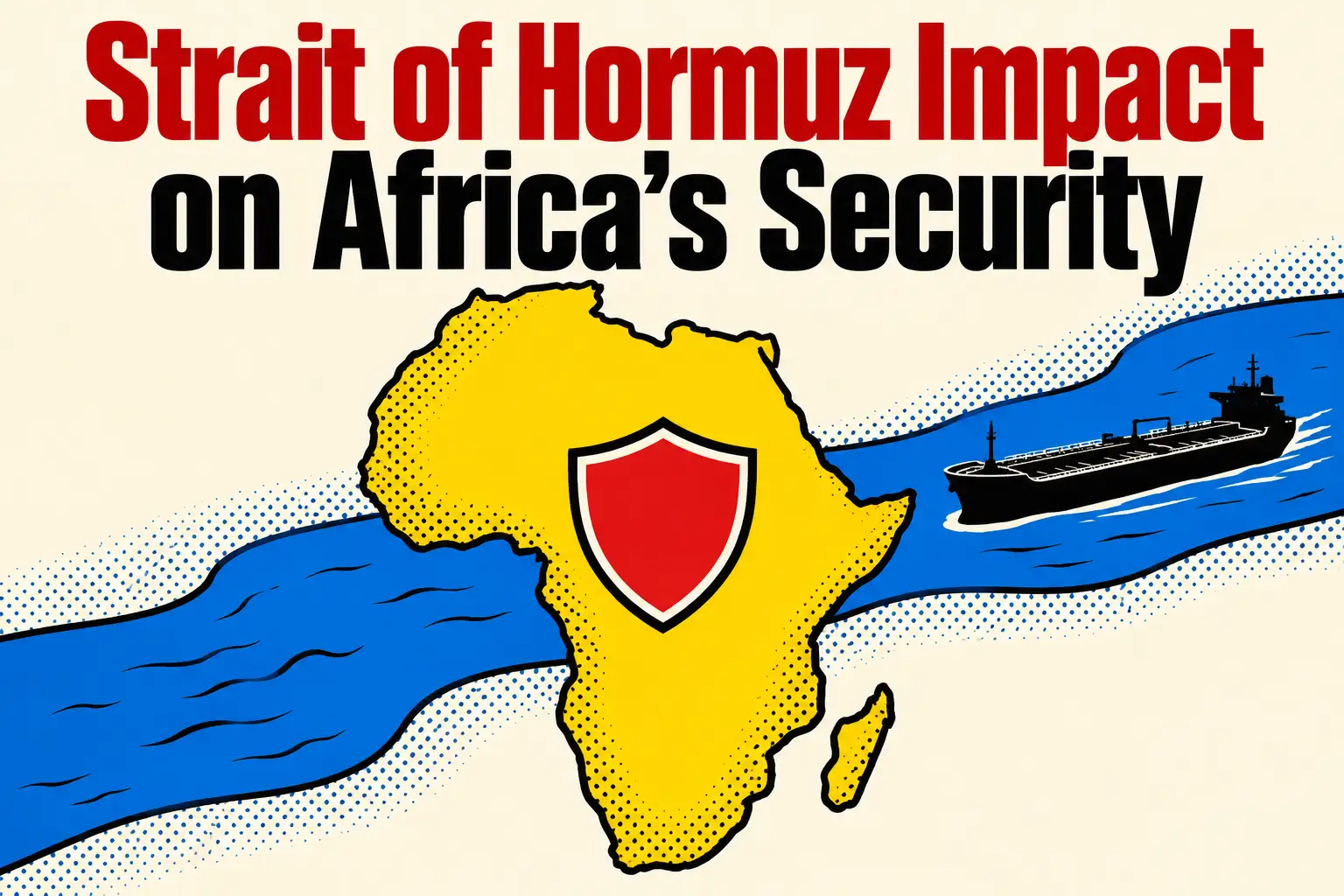
A disruption in the Strait of Hormuz would not begin as an African crisis. Its first signals would appear in Gulf shipping advisories, insurance markets and naval deployments. Yet the Strait of Hormuz impact on Africa would rapidly reach African households, treasuries, ports and security institutions. A waterway only 33 kilometres wide at its narrowest point carries a strategic burden far larger than its geography.
For African governments, the central question is not whether the continent can influence a confrontation involving Iran, the Gulf states and external naval powers. It is whether national institutions have identified where a distant maritime shock becomes a domestic vulnerability. That vulnerability runs through energy imports, fertiliser supplies, food prices, shipping costs, public finances and political stability.
Why the Strait matters to African security
The Strait of Hormuz connects the Persian Gulf with the Gulf of Oman and the wider Indian Ocean. A substantial share of globally traded crude oil and liquefied natural gas passes through it. Any credible threat to shipping – whether a blockade, mine incident, missile attack, seizure of commercial vessels or a sharp escalation in regional conflict – can move markets before physical flows are interrupted.
That distinction matters. Africa does not need a complete closure of Hormuz to feel the consequences. Higher risk premiums, rerouted vessels, delayed cargoes and precautionary stockpiling can lift prices quickly. The costs then move through supply chains already under pressure from currency weakness, debt-servicing demands and infrastructure gaps.
The continent’s exposure is uneven. Egypt, Morocco, Kenya, South Africa and many other states are deeply connected to international energy and freight markets. Landlocked countries face a second-order shock: their fuel and food costs rise at coastal entry points before being amplified by road and rail transport inland. Where public transport, power generation, agriculture and urban commerce depend on imported fuel, the economic effect becomes politically sensitive with unusual speed.
Strait of Hormuz impact on Africa’s energy equation
African oil producers may initially appear insulated, or even advantaged, by higher crude prices. Nigeria, Angola, Algeria, Libya and several emerging producers could receive higher export revenues if global supply fears push prices upward. But that benefit is neither automatic nor evenly distributed.
Much depends on production volumes, contractual arrangements, technical disruptions and the ability of governments to capture additional revenue. More critically, several oil-producing African countries remain dependent on imported refined petroleum products. A state can export crude while its citizens pay more for petrol, diesel, aviation fuel and cooking gas. This is not a contradiction. It is a consequence of insufficient refining capacity, weak storage systems and exposure to international product markets.
Higher oil prices also produce fiscal trade-offs. Export earnings can improve, but fuel subsidies become more expensive, inflation accelerates and demands for wage adjustments intensify. Governments that have recently reduced subsidies may face pressure to reverse reforms. Those that retain subsidies risk widening budget deficits at precisely the moment borrowing conditions are most restrictive.
Natural gas presents a related challenge. Qatar is a major supplier of liquefied natural gas to world markets, and any disruption around Hormuz would intensify competition for alternative cargoes. African gas-importing states could face higher prices and less dependable deliveries. African LNG exporters might find a more favourable market, but long-term contracts and limited export infrastructure constrain how quickly they can capitalise.
The strategic lesson is clear: domestic energy security cannot rest only on the possession of hydrocarbons. It depends on refining, storage, electricity-grid resilience, transport logistics and the state’s capacity to manage price shocks without destabilising its own economy.
Food, fertiliser and freight pressures
The security implications extend well beyond fuel. Energy prices shape the cost of fertiliser production, shipping, irrigation, refrigeration and road transport. A Hormuz crisis could therefore affect food systems even in countries with limited direct trade links to the Gulf.
For import-dependent markets, higher freight and commodity prices would place immediate pressure on household budgets. Wheat, rice, edible oils and other staples move through global supply chains in which fuel and insurance costs matter. For African farmers, more expensive fertiliser and diesel can reduce planting or application rates, weakening future harvests rather than merely raising today’s prices.
This is where a maritime shock can become a security concern. Food inflation has repeatedly contributed to protest, labour unrest and urban discontent across regions. It does not mechanically produce instability, and each country has its own political context. But governments should not treat commodity inflation as a narrow economic issue when it can erode public confidence, stretch security services and sharpen grievances already linked to unemployment and inequality.
Shipping insurers are also central actors in this equation. When insurers designate an area as high risk, freight rates can rise even if vessels continue sailing. Shipping companies may reroute, reduce calls or impose surcharges. African importers and exporters, often operating with limited financial buffers, absorb costs that are set far from African ports.
The Red Sea is not a substitute route
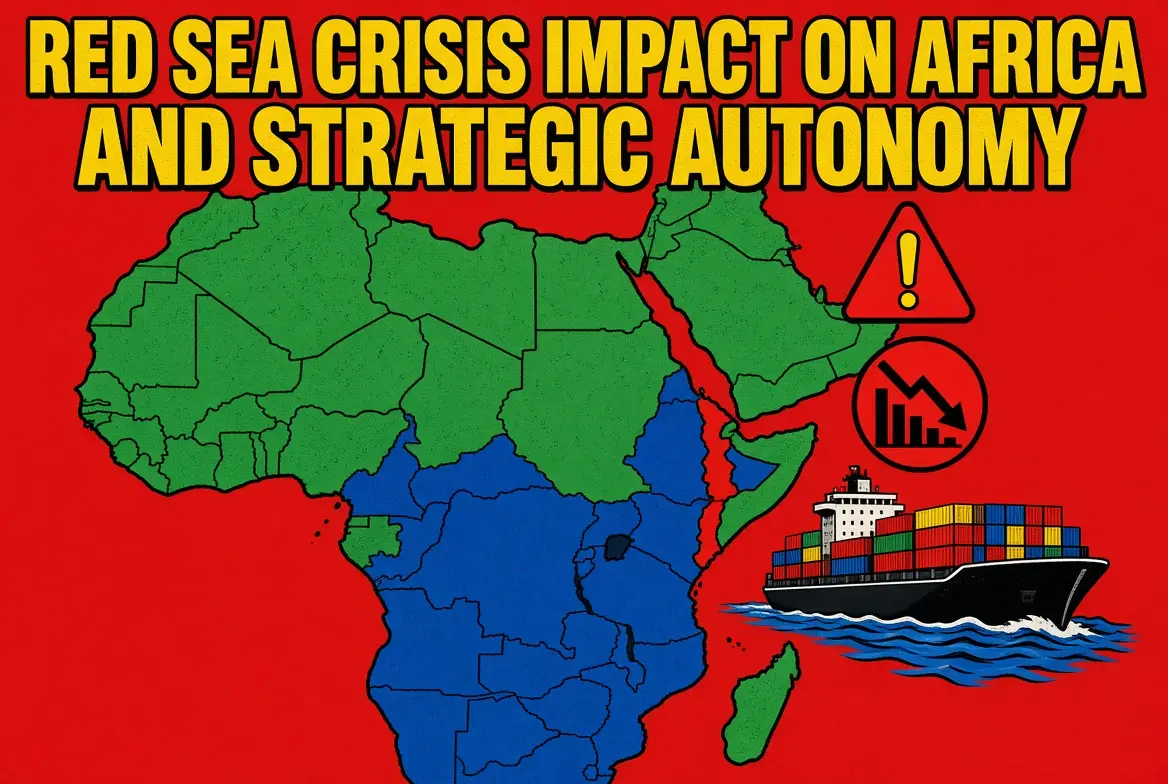
A common mistake is to view the Indian Ocean, Red Sea and Gulf shipping corridors as interchangeable. They are not. African trade already faces insecurity around the Red Sea, where attacks on commercial shipping have forced many vessels to avoid the Suez Canal route and sail around the Cape of Good Hope. A crisis at Hormuz would add pressure to a maritime system that is already strained.
For East African ports, disruption in the Gulf could affect shipping schedules, fuel availability and import timing. For Southern African ports, a larger diversion of Asia-Europe traffic around the Cape may bring commercial opportunities, but also congestion, security burdens and infrastructure demands. Ports cannot simply benefit from rerouted trade if they lack berth capacity, reliable rail links, fuel services and efficient customs procedures.
This wider geography also gives African littoral states a stronger stake in maritime domain awareness. The issue is not that African navies can police Hormuz. They cannot, and no serious strategy should pretend otherwise. The issue is whether they can understand how threats moving through the Arabian Sea, western Indian Ocean and Red Sea affect their own exclusive economic zones, port approaches, undersea infrastructure and commercial traffic.
What strategic preparation should look like
African governments should resist the temptation to respond only after petrol queues or food-price protests emerge. Preparation is less dramatic than crisis management, but it offers more sovereignty.
First, states need realistic strategic reserves for refined fuel and essential commodities, supported by transparent release rules. Storage is not glamorous infrastructure, yet it can buy governments time when global markets become disorderly. Regional pooling arrangements may be especially valuable for smaller economies that cannot finance large national reserves.
Second, policymakers should treat refinery rehabilitation, fuel-import terminals and electricity resilience as national-security investments. The most useful measure is not self-sufficiency in every product, which may be uneconomic, but reduced exposure to a single route, supplier or logistical chokepoint.
Third, finance ministries, central banks and security agencies need shared contingency planning. An energy shock is simultaneously a balance-of-payments problem, an inflation problem, a public-order risk and a strategic communications challenge. Fragmented institutions are likely to produce fragmented responses.
Fourth, African regional organisations should strengthen mechanisms for maritime intelligence-sharing and port continuity planning. Better visibility of commercial traffic, insurance changes and cargo delays will not prevent a Gulf crisis, but it enables earlier decisions on procurement, stocks and transport priorities.
Finally, African diplomacy should be guided by national interest rather than alignment theatre. The continent has an interest in freedom of navigation, the protection of civilian shipping, de-escalation and compliance with international law. It should avoid being drawn into external rivalries while speaking clearly about the economic harm that maritime coercion inflicts on vulnerable importing societies.
A test of strategic autonomy
The Strait of Hormuz is a reminder that strategic autonomy is not achieved through rhetoric about independence. It is built through capabilities that absorb external pressure: diversified supply routes, credible reserves, functioning infrastructure, sound public finance and institutions able to act before a shock becomes a crisis.
Africa cannot determine the course of confrontation in the Gulf. It can, however, decide whether events there expose familiar weaknesses or accelerate overdue investment in resilience. The most useful response is to treat every distant chokepoint as a practical question for African preparedness: what would fail first, who would bear the cost, and what can be strengthened before the next warning arrives?


Leave a Reply