
The Ghalibaf Doctrine: “You Can’t 25bp a Chokepoint”
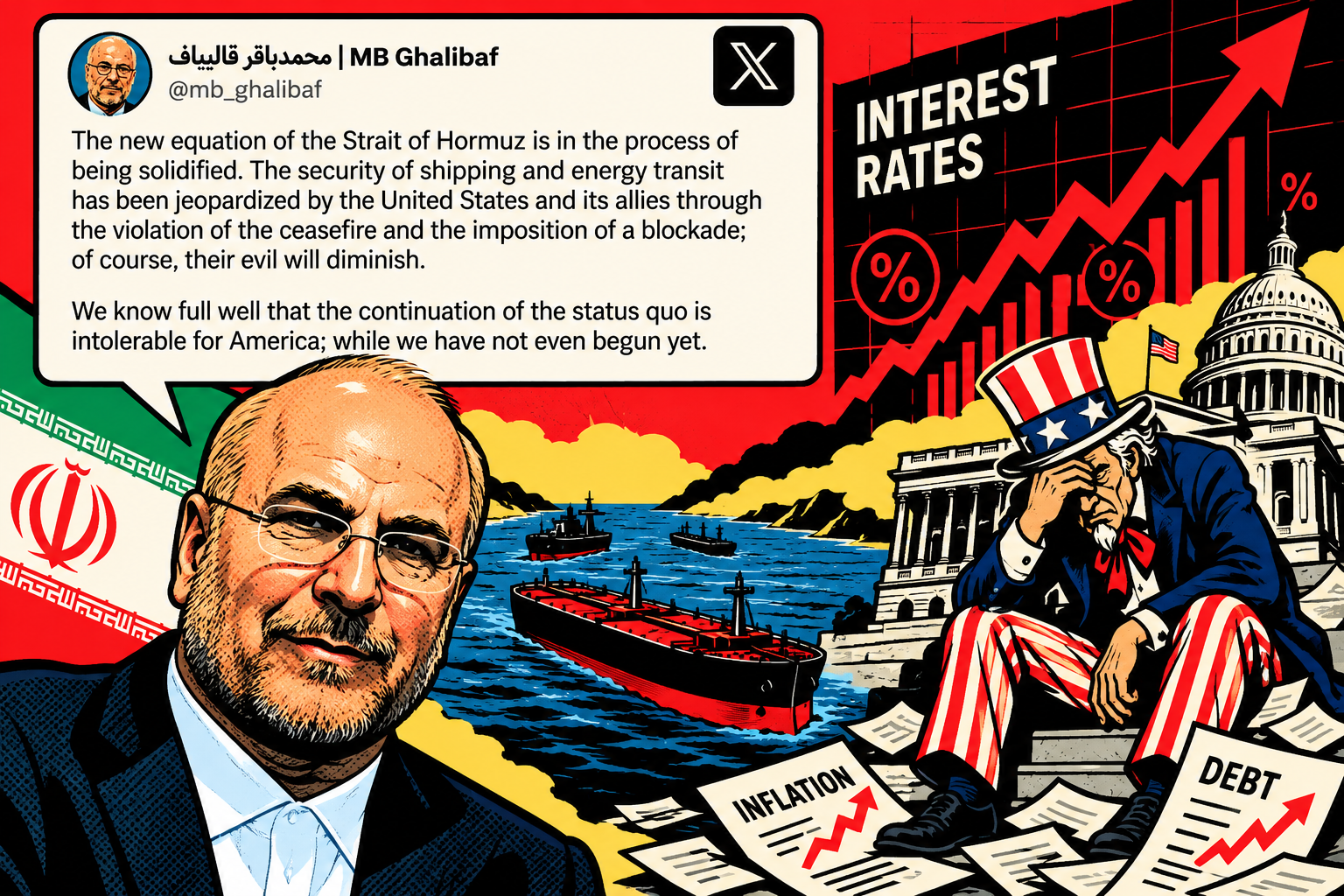
Iranian Parliament Speaker Mohammad Bagher Ghalibaf’s “Straits Taylor Rule” should be understood as more than economic trolling. It represents an emerging Iranian theory of economic deterrence built around a simple proposition: Tehran does not have to match the United States economically or militarily if it can exploit its geographical position to transmit disruption in the Persian Gulf directly into American inflation, interest rates, government borrowing costs and ultimately domestic political pressure.
Ghalibaf modified the conventional Taylor Rule, which connects interest rates to inflation and economic activity, by inserting SOH for the Strait of Hormuz and BEM for Bab el-Mandeb. His argument was straightforward. If geopolitical disruption reduces the physical supply of oil, central banks confront a problem monetary policy cannot directly solve. The Federal Reserve can increase interest rates, but it cannot manufacture crude oil. It can suppress credit demand, but it cannot repair a refinery or order an oil tanker through a contested maritime chokepoint.
The timing made Ghalibaf’s intervention particularly pointed. On September 16, the Federal Reserve raised its target range by 25 basis points to 3.75–4 percent as it sought to contain inflation. Ghalibaf argued that Washington was confronting a fundamentally different type of inflation problem. Demand-driven inflation can potentially be cooled by making borrowing more expensive, but a geopolitical supply shock is different. If fewer barrels of oil reach world markets, increasing mortgage rates in Ohio does not produce another barrel in the Persian Gulf. Hence his deliberately provocative phrase: “You can’t 25bp a chokepoint.”
Hormuz as an Instrument of Economic Warfare
The Strait of Hormuz is uniquely suited to this form of economic warfare because roughly one-fifth of global oil and gas trade traditionally passes through the waterway. The consequences of prolonged disruption therefore extend far beyond the immediate battlefield.
What emerges is an Iranian economic escalation chain. Disruption increases shipping risk; greater risk increases insurance premiums and transportation costs; those costs raise the delivered price of energy; reduced petroleum availability pushes crude and refined-product prices higher; and higher energy prices subsequently spread through transportation, agriculture, manufacturing, aviation and consumer goods.
Eventually the shock reaches American households.
By late September, Brent crude was around $105 a barrel and WTI approximately $92.60 as markets continued pricing geopolitical danger. Iran therefore does not have to physically strike the American mainland to impose economic costs on the United States. Global commodity markets can transmit part of the shock on Tehran’s behalf.
From the Persian Gulf to the Federal Reserve
This is where Ghalibaf’s argument becomes strategically significant. If oil remains above $100, petrol and diesel stay expensive. Transportation companies raise prices, airlines face larger fuel bills, manufacturers pay more for energy and food becomes more expensive to move. Consumers consequently encounter renewed inflation.
The Federal Reserve then faces an unpleasant choice: tolerate higher inflation or maintain tighter monetary policy. Neither outcome is economically or politically attractive. By September 28, markets were assigning a 73 percent probability to another quarter-point Fed increase in October amid the wider economic pressures surrounding the confrontation.
This does not mean Iran controls the Federal Reserve. American interest rates are determined by employment, productivity, fiscal policy, inflation expectations, consumer demand and numerous other variables. Ghalibaf’s implication that Tehran can effectively set American rates is political theatre.
But Iran can influence one particularly sensitive variable: energy risk.
And energy risk can migrate through the financial system.
The Second Front: America’s Treasury Market
That leads directly to what could become an even more important battlefield: US Treasury debt. When investors fear persistent inflation, they may demand higher yields for holding long-term government bonds.
By late September, the US 10-year Treasury yield had reached as high as 5.27 percent, its highest level since 2007, while American mortgage rates had moved above 7 percent.
The danger is the creation of a financial feedback loop. Higher oil prices contribute to inflation risk. Inflation risk strengthens expectations of tighter monetary policy. Higher expected interest rates place upward pressure on bond yields. Higher Treasury yields make government refinancing more expensive and simultaneously feed into mortgages, corporate borrowing, credit cards and investment decisions.
Iran’s argument is therefore that America’s enormous financial system can itself become a transmission mechanism for geopolitical pressure.
Washington’s Strategic Paradox
Washington consequently faces a paradox. It can deploy additional aircraft carriers, escort shipping, attack Iranian military infrastructure and release petroleum from strategic reserves, but every additional month of uncertainty potentially carries an economic price.
The United States had already released 40 million barrels from its Strategic Petroleum Reserve as part of attempts to stabilise energy markets. Regional economies have meanwhile begun adapting, with Iraq importing gasoline through Syria to circumvent disruption around Hormuz.
This illustrates a crucial feature of prolonged economic warfare: wars are contests not only of destruction but of adaptation.
Washington wants to restore predictable maritime flows; Tehran’s leverage depends upon preventing markets from becoming convinced that those flows are secure. Hormuz does not necessarily have to remain completely closed for a risk premium to survive. Traders, insurers and businesses merely have to believe that tomorrow’s tanker might not arrive.
Iran’s Most Powerful Weapon May Be Uncertainty
Iran’s most powerful economic weapon may therefore be uncertainty rather than destruction.
Oil markets price future supply, insurance companies price future risk, bond traders price future inflation and businesses price expected energy costs. Consumers subsequently react to expectations surrounding petrol, food, employment and borrowing.
Relatively limited disruption can therefore produce disproportionately large financial consequences when markets believe that greater escalation may follow.
This is classic asymmetric strategy: a weaker power forces a much stronger opponent to defend an enormous economic surface area. Iran cannot outspend the Pentagon, but the Pentagon cannot order financial markets to stop calculating geopolitical risk. 
Interest Rates are on the Rise.
The Danger: Iran Could Damage Its Own Strategy
There is nevertheless a potentially fatal contradiction in Tehran’s strategy. The same energy shock that damages the United States also hurts countries Iran needs.
China imports enormous quantities of energy, India depends heavily on imported crude, European economies remain vulnerable to energy inflation, Gulf producers require secure shipping and developing countries can suffer disproportionately from higher petroleum prices.
If Tehran pushes disruption too far, it could transform countries that oppose American unilateralism into governments demanding Iranian restraint.
Persistently high prices also accelerate adaptation. Governments release strategic reserves, producers maximise output, alternative pipelines become more attractive, shipping routes adjust and consumers reduce consumption. Crude shipments through Hormuz had already partially recovered despite continuing instability.
Every successful adaptation potentially reduces the effectiveness of Iran’s economic weapon.
The November Political Window
This gives the period before the November 3 US midterm elections particular strategic significance. Energy prices, inflation, mortgage costs and financial-market instability are politically sensitive because Americans experience them directly.
A distant conflict suddenly becomes domestic when filling a vehicle costs considerably more, mortgage rates exceed 7 percent or businesses increase prices. Iran therefore has an incentive to emphasise the economic consequences of prolonged confrontation.
Yet there is an important distinction between economic coercion and uncontrolled military escalation. A major attack causing large numbers of American casualties could reverse Tehran’s strategy by generating greater domestic support for an expanded US war.
Economic pressure poses a different political question:
Why are Americans paying more for this war?
That question could ultimately be more politically damaging than propaganda celebrating military attacks.
From Hormuz to the American Kitchen Table
Ghalibaf’s “Straits Taylor Rule” can therefore be interpreted as an emerging form of Iranian economic deterrence. Iran does not need conventional military parity with the United States. Tehran instead seeks to connect Persian Gulf instability with the financial wellbeing of American households.
Hormuz affects oil. Oil affects inflation. Inflation influences Federal Reserve decisions. Interest rates affect Treasury yields. Treasury yields influence mortgages and corporate borrowing. Those costs eventually affect voters.
The economic battlefield consequently stretches from the Persian Gulf through Wall Street to the American kitchen table.
There are severe limits to this strategy. Iran cannot dictate Federal Reserve policy, cannot indefinitely prevent global energy markets from adapting and cannot afford to alienate China, India and other economic partners.
Nevertheless, its underlying strategic insight is important. The United States possesses overwhelming conventional military superiority, but Iran possesses geography, and that geography sits astride one of the principal arteries of the global economy.
The Federal Reserve can increase the price of money, the US Navy can attempt to secure shipping and Washington can deploy additional military forces, but none of these measures instantly eliminates geopolitical scarcity.
Making America Pay Interest on the War
Iran’s emerging economic counter-offensive is therefore less about defeating the United States militarily than about changing Washington’s calculation of what victory is worth.
If every additional month of confrontation brings elevated oil prices, persistent inflation risk, higher Treasury yields, more expensive mortgages and increasing political pressure, Tehran will have converted geography into an instrument of asymmetric economic warfare.
That is the deeper strategic meaning behind Ghalibaf’s equation.
Iran cannot match America’s financial power, but it is trying to make America pay interest on the war.
Majemite Jaboro a defence analyst writes for DWA
Leave a Reply